
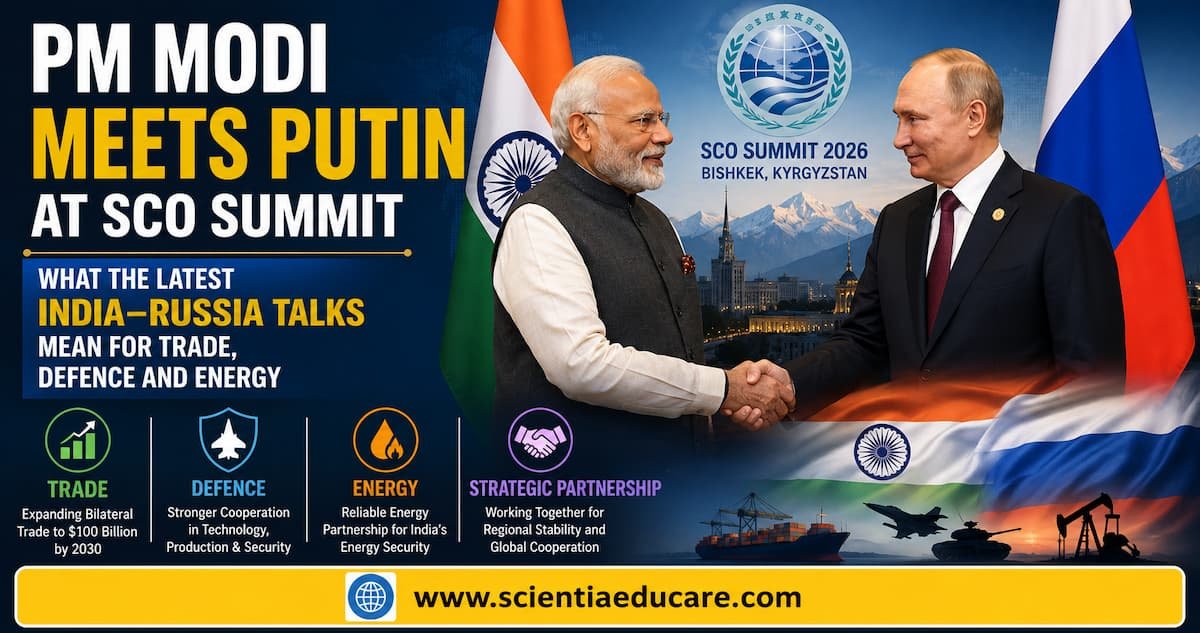
PM Modi Meets Putin at SCO Summit: What the Latest India-Russia Talks Mean for Trade, Defence and Energy
Prime Minister Narendra Modi and Russian President Vladimir Putin met on the sidelines of the 26th Shanghai Cooperation Organisation (SCO) Summit in Bishkek, Kyrgyzstan, on 31 August 2026.
The meeting comes at an important time for India-Russia relations. Despite geopolitical tensions, Western sanctions on Russia and continuing conflicts affecting global trade and energy markets, the two countries have maintained what India describes as a “Special and Privileged Strategic Partnership.”
During their latest meeting, Modi and Putin reviewed bilateral cooperation across trade, investment, defence, energy, space, mobility and people-to-people ties. They also discussed regional and global developments, including conflicts in West Asia and the Black Sea region and their impact on maritime trade and the safety of Indian seafarers.
The talks are significant not simply because two long-standing partners met again, but because they provide an indication of where India-Russia economic and strategic relations could be heading next.
So, what could the latest Modi-Putin talks mean for trade, defence, energy and India’s broader economic interests?
Modi-Putin Meeting at SCO Summit: Key Highlights
The meeting between Narendra Modi and Vladimir Putin was their first meeting of 2026. Their previous meeting took place in New Delhi during the 23rd Annual India-Russia Summit in December 2025.
The latest talks covered:
- Bilateral trade and investment
- Defence cooperation
- Energy security
- Space cooperation
- Fertiliser supplies
- Connectivity and mobility
- People-to-people ties
- Regional security
- Maritime trade
- The Russia-Ukraine conflict
- India-Russia cooperation through BRICS and other multilateral platforms
The two leaders also welcomed progress from the 27th India-Russia Inter-Governmental Commission on Trade, Economic and Cultural matters, which was held in Moscow on 24 August 2026.
Putin is also expected to visit India for the 18th BRICS Summit in New Delhi on 12–13 September 2026, giving the two countries another opportunity for high-level engagement within weeks of the SCO meeting.
Why Is the Modi-Putin Meeting Important?
India-Russia relations have traditionally rested on three major pillars:
Defence + Energy + Strategic Cooperation
However, the economic relationship has changed considerably in recent years.
Russia has become a major source of energy and other commodities for India, while India is seeking to expand its exports to Russia and create a more balanced trade relationship.
At the same time, defence cooperation is evolving from a traditional buyer-seller model toward greater emphasis on joint production, technology cooperation and localisation.
The latest meeting therefore comes at a time when both countries are attempting to broaden their relationship beyond conventional areas of cooperation.
India-Russia Trade: A Relationship That Has Grown Rapidly
One of the most important aspects of India-Russia relations is the dramatic increase in bilateral trade.
According to Indian government data, bilateral trade reached a record US$68.7 billion in FY2024–25. India’s exports to Russia were about US$4.9 billion, while imports from Russia were approximately US$63.8 billion.
This makes the trade relationship extremely important—but also highly imbalanced.
India-Russia Trade Snapshot
| Indicator | FY2024–25 |
|---|---|
| Total bilateral trade | US$68.7 billion |
| India’s exports to Russia | US$4.9 billion |
| India’s imports from Russia | US$63.8 billion |
| Long-term bilateral trade target | US$100 billion by 2030 |
India’s major exports to Russia include:
- Pharmaceuticals
- Chemicals
- Iron and steel
- Marine products
- Other manufactured and agricultural products
Major Indian imports from Russia include:
- Crude oil and petroleum products
- Fertilisers
- Sunflower oil
- Coking coal
- Precious stones and metals
The Biggest Trade Challenge: The Trade Imbalance
The headline trade figure looks impressive, but the structure of the relationship presents a major challenge.
India imports far more from Russia than it exports.
This means the next phase of India-Russia economic cooperation will likely focus increasingly on expanding Indian exports.
That could create opportunities for Indian companies in sectors such as:
- Pharmaceuticals
- Engineering goods
- Chemicals
- Agricultural products
- Textiles
- Food processing
- Automotive components
- Electronics
- Machinery
- Information technology and professional services
The two countries have already been working on reducing trade barriers, improving logistics and payment mechanisms and expanding market access.
The broader objective is to move toward the US$100 billion bilateral trade target by 2030.
Why Payment Systems and Connectivity Matter
Trade cannot expand significantly unless businesses can move goods and settle payments efficiently.
India and Russia have therefore been working on issues involving:
- Alternative payment mechanisms
- Banking connectivity
- Logistics
- Transport corridors
- Customs procedures
- Market access
- Trade barriers
The Department of Commerce has identified payment mechanisms, logistics bottlenecks, connectivity and trade barriers as important areas of cooperation.
This is particularly important because geopolitical tensions and sanctions have complicated traditional international payment and shipping arrangements.
For Indian exporters, improved payment and logistics systems could make it easier to access the Russian market.
Defence: An Enduring Pillar of India-Russia Relations
Defence remains one of the strongest foundations of the India-Russia strategic partnership.
India and Russia have decades of defence cooperation involving aircraft, helicopters, missiles, tanks, submarines and other military systems.
But the nature of this relationship is changing.
India is increasingly focused on domestic manufacturing, technology transfer and joint production, rather than simply importing complete weapons systems.
The India-Russia military-technical cooperation framework for 2021–2031 focuses on areas including joint research, development, production and after-sales support for defence equipment.
This could be particularly important for India’s Make in India and Atmanirbhar Bharat objectives.
What Could the Latest Talks Mean for Defence?
The official readout of the August 31 meeting says the two leaders reviewed defence cooperation, but it does not announce a specific new major weapons contract.
That distinction is important.
The significance of the meeting is therefore less about a single headline defence purchase and more about maintaining and potentially expanding long-term defence cooperation.
Possible areas of importance include:
1. Joint Production
Greater production of defence equipment within India could reduce dependence on imports and strengthen domestic manufacturing capabilities.
2. Technology Cooperation
Technology transfer and joint research can help India develop more advanced defence capabilities.
3. Maintenance and Spare Parts
Russia remains an important supplier of equipment and support for platforms already used by India’s armed forces.
Reliable supply chains for spare parts and maintenance remain strategically important.
4. Future Military Platforms
India will continue evaluating different suppliers and technologies based on operational requirements, cost, technology and strategic considerations.
This means Russia remains important, but India’s defence procurement is increasingly diversified.
Energy: One of the Most Important Areas of Cooperation
Energy has become one of the defining features of India-Russia economic relations.
Russian oil and petroleum products account for a major portion of India’s imports from Russia.
For India, access to affordable and reliable energy is essential because crude oil prices directly influence:
- Transport costs
- Inflation
- Manufacturing expenses
- Logistics costs
- Household budgets
- India’s current account
- Overall economic growth
Russia, meanwhile, has become an important supplier in India’s energy import basket.
This makes energy cooperation strategically significant for both countries.
Why Russian Oil Matters to India
India is one of the world’s largest energy-consuming economies and remains heavily dependent on imported crude oil.
When Indian refiners can obtain crude at commercially attractive prices, the benefits can extend across the economy.
Lower input costs can potentially support:
Lower energy costs → lower transportation costs → lower production costs → reduced inflationary pressure
However, energy trade is not determined by India and Russia alone.
It is also influenced by:
- Global oil prices
- Sanctions
- Shipping and insurance costs
- Payment mechanisms
- Refinery economics
- International trade policies
- Geopolitical developments
The Modi-Putin meeting therefore comes at a time when energy security remains a major strategic priority for India.
Fertilisers: Another Critical Area
Energy is not the only commodity connection between the two countries.
Russia is also an important source of fertilisers for India.
Fertiliser availability is particularly important for India’s agricultural sector.
Affordable and reliable fertiliser supplies can help support:
- Farmers
- Agricultural production
- Food security
- Rural incomes
- Food-price stability
Therefore, India-Russia cooperation in this area has implications beyond foreign policy—it can affect the wider Indian economy.
Russia-Ukraine War: Why It Remains Part of the Conversation
The Russia-Ukraine conflict continues to influence India-Russia relations.
During the latest meeting, Prime Minister Modi stressed India’s support for dialogue, diplomacy and efforts toward peace. He said that the world should move from “endless wars” toward ending wars, according to reports of his remarks.
India’s position is important because New Delhi has maintained strategic relations with Russia while simultaneously developing strong relationships with the United States, Europe, Japan and other partners.
This reflects India’s broader approach of maintaining strategic autonomy.
India wants to preserve its national interests while avoiding being locked into any single geopolitical bloc.
Maritime Security Is Becoming More Important
The latest Modi-Putin talks also touched on conflicts in West Asia and the Black Sea region and their effects on maritime trade and the safety of Indian seafarers.
This is economically significant.
India’s economy depends heavily on international shipping for:
- Crude oil
- Fertilisers
- Industrial raw materials
- Manufactured goods
- Exports
- Imports
Disruptions to major shipping routes can increase:
- Freight rates
- Insurance costs
- Delivery times
- Energy prices
- Supply-chain expenses
Therefore, maritime security is increasingly becoming an economic issue as well as a strategic one.
What Does This Mean for Indian Businesses?
The latest India-Russia talks could create opportunities for Indian businesses if bilateral trade becomes more balanced and diversified.
Potential growth areas include:
Pharmaceuticals
Indian pharmaceutical companies have an established presence in international markets and could potentially expand their Russian business.
Engineering and Machinery
Growing industrial cooperation could increase opportunities for Indian engineering companies.
Agriculture and Food Products
India can potentially expand exports of agricultural and processed food products.
Chemicals
Chemicals are already among India’s major exports to Russia.
Textiles
Indian textile and apparel companies could explore greater access to the Russian market.
Technology and Services
As bilateral economic relations broaden, opportunities could emerge in IT, digital services, consulting and other professional services.
What Does This Mean for Indian Consumers?
India-Russia relations may appear distant from everyday life, but the economic relationship can affect ordinary consumers.
Energy imports can influence fuel and transportation costs.
Fertiliser supplies can affect agriculture and food production.
Trade and investment can support industrial activity and employment.
Defence cooperation can strengthen India’s strategic capabilities.
In simple terms:
India-Russia relations are not only about diplomacy—they can have direct economic consequences for Indian households and businesses.
What Does This Mean for India’s Energy Security?
Energy security is likely to remain one of the most important reasons India values its relationship with Russia.
India’s strategy is not simply about buying oil from one country.
It is about maintaining a diversified energy supply base while securing reliable and economically viable imports.
Russia provides India with another major source of crude and energy products.
At the same time, India continues to engage with energy suppliers across the Middle East and other regions.
This diversification helps India manage supply risks in a volatile global energy market.
What Does This Mean for India’s Defence Strategy?
The latest meeting reinforces the continued relevance of Russia to India’s defence ecosystem.
However, India’s defence strategy is becoming increasingly diversified.
India is simultaneously expanding cooperation with countries such as the United States, France, Israel and other partners.
Therefore, the future of India-Russia defence cooperation is likely to focus increasingly on:
- Technology
- Joint development
- Local manufacturing
- Maintenance
- Supply-chain reliability
- Advanced systems
- Long-term industrial partnerships
This represents a gradual shift from buyer-seller relations toward technology and production partnerships.
BRICS Summit: The Next Important Stage
The Modi-Putin meeting at the SCO Summit also has significance because Russia’s President is scheduled to visit India for the BRICS Summit on 12–13 September 2026.
That upcoming visit could provide another opportunity to discuss:
- Bilateral trade
- Investment
- Energy
- Defence
- BRICS cooperation
- Global economic governance
- Regional security
- International payment systems
- Connectivity
The SCO meeting can therefore be viewed as part of a broader sequence of India-Russia diplomatic and economic engagement.
Can India and Russia Reach $100 Billion in Trade?
India and Russia have set an ambitious objective of reaching US$100 billion in annual bilateral trade by 2030.
The target is achievable only if the trade basket becomes broader and more balanced.
Simply increasing commodity imports would not address India’s trade imbalance.
India would need to significantly increase exports of:
- Pharmaceuticals
- Engineering products
- Chemicals
- Agricultural goods
- Food products
- Textiles
- Machinery
- Technology services
- Other manufactured products
At the same time, both countries would need to address logistics, payment and market-access challenges.
The Biggest Opportunities Ahead
The latest talks suggest that the future India-Russia relationship could increasingly be built around economic diversification.
Trade
Moving beyond oil and commodities toward a broader basket of manufactured goods and services.
Defence
Expanding joint production, technology cooperation and local manufacturing.
Energy
Maintaining reliable energy supplies while exploring wider cooperation.
Space
Strengthening cooperation in one of the most technologically advanced areas of the relationship.
Connectivity
Improving transport and logistics links between India and Russia.
Investment
Encouraging companies from both countries to invest in manufacturing, energy, technology and other sectors.
The Key Challenges
Despite the positive strategic relationship, several challenges remain.
1. Trade Imbalance
India imports far more from Russia than it exports.
2. Sanctions and Geopolitical Risks
International sanctions can complicate payments, logistics, insurance and technology cooperation.
3. Shipping Disruptions
Conflicts affecting major maritime routes can increase costs.
4. Payment Mechanisms
Efficient and compliant financial channels remain important for expanding trade.
5. Market Access
Indian exporters need easier access to the Russian market, while businesses must navigate regulatory and logistical requirements.
6. Defence Diversification
India is increasingly sourcing defence equipment from multiple countries, which changes the traditional structure of India-Russia defence ties.
What the Modi-Putin Talks Really Signal
The most important message from the latest meeting is that India-Russia relations remain resilient but are evolving.
India is not abandoning its long-standing partnership with Russia.
At the same time, the relationship is no longer limited to traditional defence cooperation.
Economic relations, energy security, technology, space, investment, connectivity and people-to-people links are becoming increasingly important.
The two countries are also attempting to navigate a much more complicated international environment.
For India, the objective is clear: protect national interests while maintaining strategic autonomy and strong relationships with multiple global powers.
For Russia, maintaining strong economic and strategic relations with India provides an important partnership in Asia.
Conclusion
Prime Minister Narendra Modi’s meeting with President Vladimir Putin at the 2026 SCO Summit in Bishkek reinforces the continuing importance of India-Russia relations.
The talks covered a broad range of areas, including trade, investment, defence, energy, space, mobility and people-to-people ties, while also addressing regional conflicts and their effects on maritime trade and security.
For India, the relationship offers important advantages in energy security, defence cooperation, fertiliser supplies and strategic diplomacy.
For Indian businesses, the bigger opportunity lies in expanding exports and creating a more balanced trade relationship.
For the defence sector, the future may increasingly involve joint production, technology and local manufacturing rather than conventional arms purchases alone.
For energy security, Russia remains an important supplier—but India is likely to continue diversifying its sources.
And for India’s foreign policy, the meeting demonstrates the continuing importance of strategic autonomy.
The next major milestone will be President Putin’s expected visit to India for the BRICS Summit on 12–13 September 2026.
If the momentum from the SCO meeting continues, the coming months could be important for determining how India and Russia reshape their economic and strategic partnership for the next phase.
The India-Russia relationship is changing—but it is far from weakening. Its future will increasingly depend on whether both countries can convert political trust into stronger trade, technology, investment, energy security and mutually beneficial economic opportunities.
Frequently Asked Questions (FAQs)
1. When did PM Modi meet Vladimir Putin at the SCO Summit?
Prime Minister Narendra Modi met Russian President Vladimir Putin on 31 August 2026 on the sidelines of the 26th SCO Summit in Bishkek, Kyrgyzstan.
2. What did Modi and Putin discuss?
The leaders reviewed cooperation in trade, investment, defence, energy, space, mobility and people-to-people ties, along with regional and global issues.
3. How much is India-Russia bilateral trade?
Bilateral trade reached approximately US$68.7 billion in FY2024–25, according to Indian government data.
4. What does India import from Russia?
Major imports include crude oil and petroleum products, fertilisers, sunflower oil, coking coal and precious stones and metals.
5. What does India export to Russia?
Major Indian exports include pharmaceuticals, chemicals, iron and steel and marine products, with opportunities to expand engineering, agricultural and manufactured-goods exports.
6. Is India buying new defence equipment from Russia?
The latest official meeting statement confirms that defence cooperation was reviewed, but it does not announce a specific major new defence purchase.
7. Why is Russia important to India’s energy security?
Russia is a major supplier of crude oil and petroleum products to India. Energy cooperation therefore plays an important role in India’s efforts to maintain reliable and economically viable energy supplies.
8. What is India’s trade target with Russia?
India and Russia have an ambitious objective of reaching US$100 billion in annual bilateral trade by 2030.
9. When is Putin expected to visit India next?
President Putin is expected to visit India for the 18th BRICS Summit on 12–13 September 2026, according to the Indian government’s statement following the Modi-Putin meeting.