

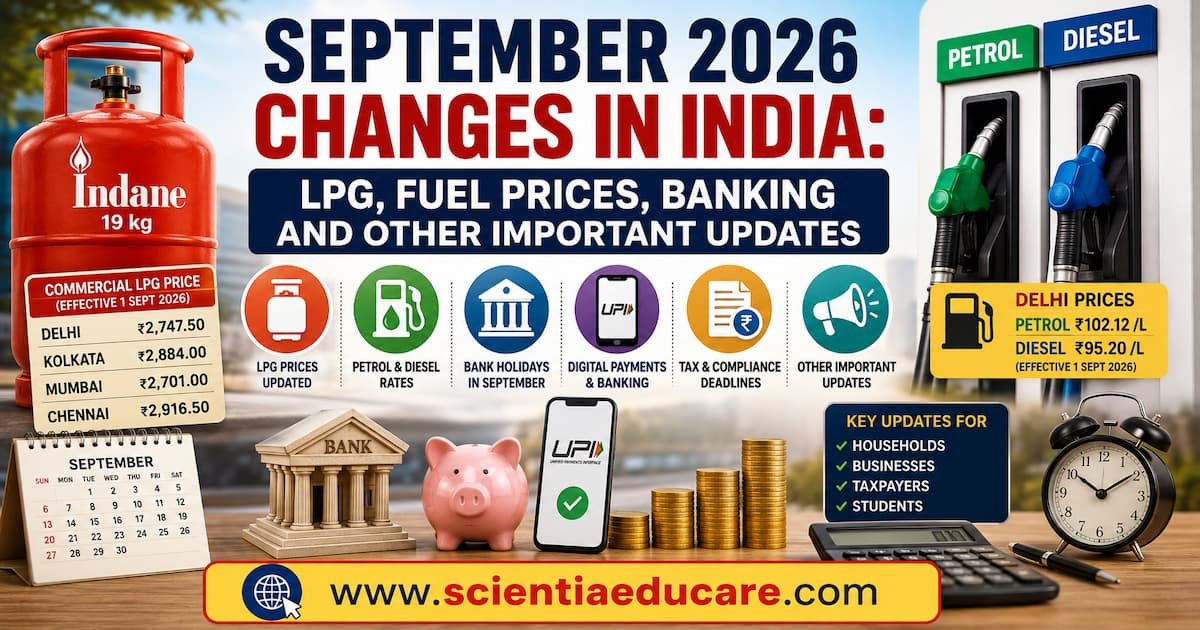
September 2026 Changes in India: LPG, Fuel Prices, Banking and Other Important Updates
Published: 1 September 2026
Category: India News | Economy | Personal Finance | Current Affairs
September 2026 begins with several important financial, fuel, banking and consumer-related developments that Indians should keep track of. From commercial LPG prices and petrol-diesel rates to banking holidays, tax-related deadlines and changes affecting household budgets, these updates may have different implications for consumers, businesses and taxpayers.
Here is a detailed look at the most important September 2026 changes and updates in India.
1. Commercial LPG Cylinder Prices Increase From September 1
One of the most noticeable changes at the beginning of September is the revision of commercial LPG cylinder prices.
According to IndianOil’s latest published price information, effective 1 September 2026, the price of a 19-kg Indane commercial LPG cylinder is listed at:
| City | 19-kg Commercial LPG Price |
|---|---|
| Delhi | ₹2,747.50 |
| Kolkata | ₹2,884.00 |
| Mumbai | ₹2,701.00 |
| Chennai | ₹2,916.50 |
These figures are based on IndianOil’s metropolitan price listing and can differ in other locations.
The increase is particularly relevant to restaurants, hotels, food businesses, caterers, small commercial establishments and other users of commercial LPG.
What About Domestic LPG?
Consumers should distinguish between commercial LPG and domestic LPG. IndianOil’s published metropolitan prices for a non-subsidised 14.2-kg Indane cylinder were last updated on 7 June 2026, at ₹942 in Delhi, ₹968 in Kolkata, ₹941.50 in Mumbai and ₹957.50 in Chennai.
Therefore, consumers should not automatically assume that a revision in commercial-cylinder prices means that the domestic 14.2-kg cylinder has increased by the same amount.
2. Petrol and Diesel Prices Remain a Key September Watchpoint
Fuel prices continue to be an important monthly concern for Indian consumers.
The Petroleum Planning & Analysis Cell (PPAC) lists the 1 September 2026 Delhi retail selling price at:
- Petrol: ₹102.12 per litre
- Diesel: ₹95.20 per litre
However, petrol and diesel prices vary across cities because of differences in state taxes, local levies and other components of the retail price.
IndianOil also notes that prices can vary from outlet to outlet within a city or sales area.
Why Fuel Prices Matter
Changes in fuel prices can have a wider economic impact because transportation costs influence:
- Public and private transport
- Delivery charges
- Logistics expenses
- Agricultural operations
- Manufacturing costs
- Food and consumer-goods prices
Consequently, fuel prices are important not only for vehicle owners but also for the broader economy.
3. Petroleum Export Duty Structure Changes
Another important energy-sector development from 1 September is a change in India’s petroleum export duty structure.
Reports on the latest revision state that the diesel export levy has been reduced from ₹3 per litre to ₹1 per litre, while the windfall tax has been set at ₹19.
Such changes are more directly relevant to oil companies and the petroleum industry than to ordinary consumers.
Nevertheless, they are worth following because India’s petroleum taxation and export policies can influence government revenues, refinery economics and the broader energy market.
4. Banking Customers Should Check September Holidays
September includes several bank holidays, and the dates vary by state and city.
The Reserve Bank of India’s September 2026 holiday matrix lists holidays for different centres on dates including 4, 11, 12, 14, 15, 21, 22, 23 and 25 September, although the applicable holiday depends on the location.
This is particularly important for people planning:
- Cash deposits or withdrawals
- Cheque-related transactions
- Bank visits
- Loan-related documentation
- Demand drafts
- Other branch-dependent services
Are Online Banking Services Available?
A bank holiday does not necessarily mean that digital banking services stop functioning. Customers can generally continue using services such as internet banking, mobile banking and digital payments, subject to their bank’s systems and scheduled maintenance.
UPI continues to be a major digital-payment infrastructure in India. NPCI’s latest published statistics show 23,658.35 million UPI transactions in July 2026, with transaction value of approximately ₹29.88 lakh crore.
5. Bank Charges and Service Fees Need Attention
Another issue receiving attention at the start of September is the possibility of changes to banking charges and service fees.
However, this should not be presented as a single nationwide “new bank charge” applicable to every customer. Charges can depend on the bank, account type and specific service.
Customers should therefore check their bank’s latest schedule of charges rather than relying on general social-media messages or headlines.
The Reserve Bank of India’s August 2026 circular database also shows several recent regulatory developments involving banks and financial institutions, including amendments relating to commercial banks and small finance banks.
6. Taxpayers Should Pay Attention to September Deadlines
September is also an important month for taxpayers and businesses.
Some income-tax and other financial deadlines fall around the beginning of the month, while other compliance dates occur later in September.
Importantly, 31 August 2026 was a significant deadline for certain taxpayers, including specified income-tax return filing categories.
Taxpayers should therefore check their individual filing requirements rather than assuming that every taxpayer has the same deadline.
For businesses, September also brings regular GST and other compliance responsibilities.
7. LPG e-KYC and Consumer Verification
LPG consumers should also pay attention to KYC and authentication requirements.
Reports published ahead of September highlighted LPG e-KYC as an important deadline for eligible consumers.
Consumers should use the official LPG distributor or oil-company channels for verification and avoid sharing OTPs, passwords, bank details or other sensitive information with unknown callers.
8. Aviation Fuel Prices Can Affect Air Travel
Another monthly energy-price development involves Aviation Turbine Fuel (ATF).
ATF prices are reviewed periodically and are important because aviation fuel is one of the major operating expenses for airlines. Changes in ATF prices can therefore influence airline operating costs and, depending on market conditions, ticket pricing.
IndianOil publishes metropolitan ATF prices as part of its petroleum-product price information.
For travellers, however, an increase or decrease in ATF prices does not automatically mean an equivalent change in airfares, because ticket prices also depend on demand, competition, taxes, route economics and airline pricing strategies.
9. The Rupee-Dollar Exchange Rate Remains Important
Currency movements are another factor worth watching in September.
On 1 September 2026, the Indian rupee strengthened to around ₹94.95 per US dollar, with Reuters reporting that RBI intervention and dollar inflows supported the currency.
The exchange rate matters because India imports significant quantities of crude oil and other commodities.
A weaker rupee can increase the rupee cost of imports, while currency movements also matter to:
- Students studying abroad
- International travellers
- Importers
- Exporters
- Companies with foreign-currency exposure
- Investors
10. What These September Changes Mean for Ordinary Indians
Not every change affects every household equally.
For households
The most relevant areas are LPG, petrol, diesel, food and transportation costs.
For small businesses
Restaurants, hotels, caterers and other commercial LPG users may be more directly affected by commercial-cylinder price changes.
For bank customers
People should check their local bank holiday calendar and applicable service charges before visiting a branch or carrying out branch-dependent transactions.
For taxpayers
September should be treated as a month for reviewing income-tax, GST and other compliance deadlines.
For students
Changes in the rupee-dollar exchange rate can matter particularly to students planning overseas education because tuition fees and living expenses abroad are generally paid in foreign currencies.
September 2026: Quick Checklist for Consumers
Before moving through the month, Indian consumers should consider the following:
✔ Check the latest LPG price applicable to your cylinder category and city.
✔ Check local petrol and diesel prices before budgeting for fuel.
✔ Check your bank’s September holiday schedule before visiting a branch.
✔ Review your bank’s latest schedule of charges if you regularly use paid banking services.
✔ Check your income-tax and GST deadlines if applicable to you.
✔ Complete any required LPG KYC or authentication through official channels.
✔ Avoid believing viral messages claiming that a particular rule applies nationwide without checking an official source.
Conclusion
September 2026 begins with several developments that can influence household expenses, business costs, banking activities and personal financial planning in India.
The most immediate changes include the revision of commercial LPG prices, the latest petrol and diesel rates, petroleum-sector tax changes and the month’s regional bank holidays. At the same time, taxpayers and businesses need to remain alert to their individual compliance deadlines.
The important point is that not every September change applies to everyone. LPG prices differ by cylinder type and location, fuel prices differ by city, bank holidays vary by region, and tax deadlines depend on the taxpayer’s circumstances.
Therefore, consumers should verify important financial information through official government, RBI, bank, oil-company and other authorised sources before making financial decisions.
Frequently Asked Questions
Q1. Did domestic LPG prices increase from September 1, 2026?
IndianOil’s published metropolitan data shows the non-subsidised 14.2-kg domestic Indane prices were last updated on June 7, 2026, while the 19-kg commercial-cylinder prices were updated on September 1. Consumers should therefore distinguish between domestic and commercial LPG.
Q2. What is the petrol price in Delhi on September 1, 2026?
PPAC lists the Delhi petrol retail selling price at ₹102.12 per litre on September 1, 2026.
Q3. What is the diesel price in Delhi?
PPAC lists the Delhi diesel retail selling price at ₹95.20 per litre on September 1, 2026.
Q4. Will banks remain closed throughout September?
No. Bank holidays are specific to dates and locations. The RBI’s holiday matrix should be checked for the relevant city or state.
Q5. Will UPI work on bank holidays?
UPI is a digital payment system and is generally available independently of branch holidays, although individual bank or network outages and maintenance can affect transactions. NPCI continues to report large-scale UPI transaction volumes.
LPG price September 2026, petrol diesel price September 2026, bank holidays September 2026, India financial changes 2026, September 1 changes India