

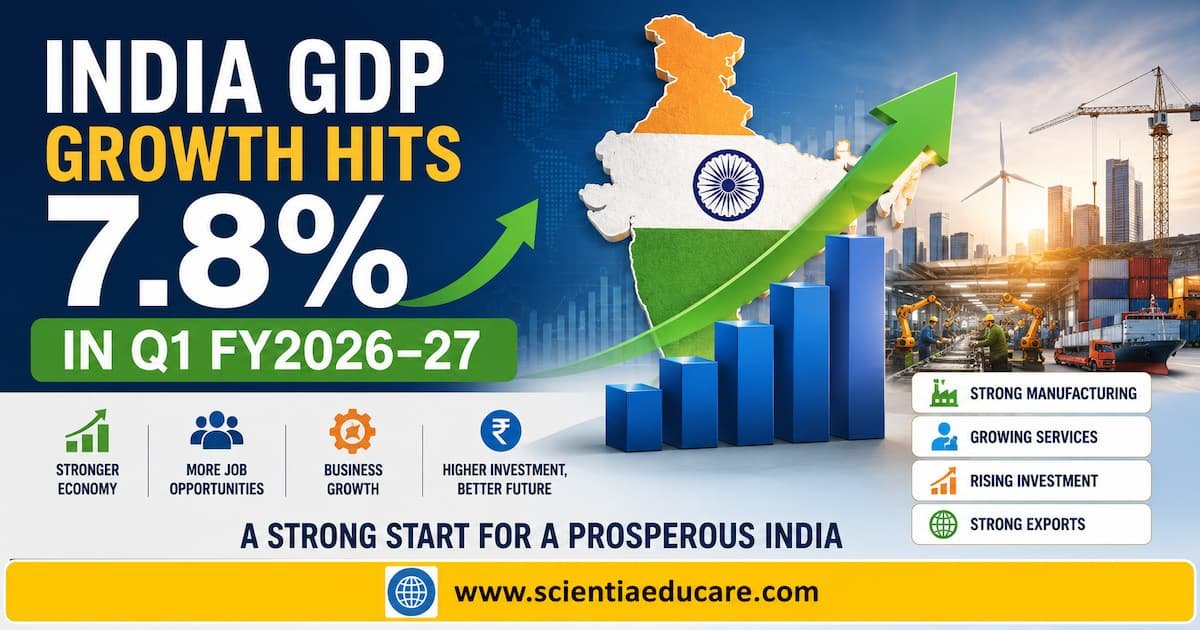
India GDP Growth Hits 7.8% in Q1 FY2026–27: What It Means for the Economy, Jobs and Businesses
India’s economy has started the financial year 2026–27 on a strong note, with real GDP growing by 7.8% in the April–June 2026 quarter. The latest figures released by the Ministry of Statistics and Programme Implementation (MoSPI) show that economic activity remained resilient despite global uncertainties and geopolitical headwinds.
The 7.8% growth rate is significantly higher than the 6.9% growth recorded in Q1 FY2025–26 and also exceeded the Reserve Bank of India’s earlier estimate of 7.0% for the quarter.
But what does this impressive GDP number actually mean for ordinary Indians, job seekers, entrepreneurs, investors and businesses?
Let’s examine the numbers and their wider economic impact.
India GDP Growth at 7.8%: The Key Numbers
According to the latest official estimates, India’s real GDP increased from ₹75.46 lakh crore in Q1 FY2025–26 to approximately ₹81.36 lakh crore in Q1 FY2026–27, representing 7.8% year-on-year growth.
At current prices, nominal GDP rose by 10.3%, reaching approximately ₹88.27 lakh crore compared with ₹80.00 lakh crore in the corresponding quarter of the previous year.
Another important indicator is Gross Value Added (GVA). Real GVA grew by 8.2%, while nominal GVA increased by 11.5%.
Q1 FY2026–27 GDP Snapshot
| Indicator | Q1 FY2025–26 | Q1 FY2026–27 | Growth |
|---|---|---|---|
| Real GDP | ₹75.46 lakh crore | ₹81.36 lakh crore | 7.8% |
| Nominal GDP | ₹80.00 lakh crore | ₹88.27 lakh crore | 10.3% |
| Real GVA | ₹68.21 lakh crore | ₹73.82 lakh crore | 8.2% |
| Nominal GVA | ₹72.24 lakh crore | ₹80.53 lakh crore | 11.5% |
These figures indicate that the economy is not merely expanding in headline GDP terms; economic value added across sectors is also showing strong momentum.
Why Is India’s Economy Growing So Fast?
The latest data points to strength across several parts of the economy, particularly manufacturing, services, investment, consumption and exports.
The government’s latest economic factsheet notes that investment grew by 11.9%, household consumption increased by 7.1%, and exports rose by 12.0% during Q1 FY2026–27.
Several high-frequency indicators also showed strong performance.
For example, capital goods production increased by 15.2%, electrical equipment manufacturing rose by 27%, computer, electronic and optical products grew by 12.4%, while commercial vehicle sales increased by 18.3% during the quarter.
This suggests that the current growth story is being supported by a combination of domestic demand, investment activity, industrial production and services.
Manufacturing and Industry Provide a Major Boost
One of the most encouraging aspects of the latest GDP numbers is the performance of the secondary sector.
The secondary sector—which includes manufacturing, construction, electricity, gas, water supply and other utilities—recorded 8.6% growth at constant prices in Q1 FY2026–27.
Manufacturing activity is particularly important because it can create demand across a broad supply chain.
When factories expand production, demand can increase for:
- Raw materials
- Transportation
- Warehousing
- Logistics
- Engineering services
- Packaging
- Equipment
- Financial services
- Skilled and semi-skilled labour
The latest official indicators show strong growth in several industrial categories. Electrical equipment manufacturing grew 27%, while machinery and equipment manufacturing increased 9.1%.
What does this mean for businesses?
For manufacturers and suppliers, stronger industrial activity can translate into:
Higher orders → greater production → increased hiring → stronger supplier demand → higher business investment.
However, businesses will still need to monitor input costs, global trade conditions and supply-chain disruptions.
Services Sector Remains India’s Economic Engine
India’s services sector continues to play a central role in economic expansion.
The tertiary sector grew by approximately 10% at constant prices in Q1 FY2026–27. Financial, real estate, IT and professional services recorded particularly strong growth of 12.1%.
This is important because India’s services ecosystem includes a wide range of activities, such as:
- Information technology
- Banking and financial services
- Insurance
- Real estate
- Professional consulting
- Telecommunications
- Transportation
- Hospitality
- Education
- Healthcare
- Digital services
Strong services growth can support both urban employment and entrepreneurship.
For students and young professionals, this could mean continued opportunities in areas such as technology, finance, data analytics, digital marketing, accounting, consulting, logistics and professional services.
What Does 7.8% GDP Growth Mean for Jobs?
GDP growth does not automatically mean that every person will get a better-paying job.
However, sustained economic expansion generally creates a more favourable environment for employment when growth translates into increased production, investment and business activity.
The latest data provides some encouraging signs.
India’s unincorporated non-agricultural sector—covering a major part of small businesses and informal enterprises—recorded 13.70 crore workers in April–June 2026, representing 6.55% year-on-year growth. The number of establishments increased by 9.20% to 8.67 crore.
The services segment was particularly strong, with its estimated workforce increasing by more than 21% year-on-year in the quarterly survey.
This is significant because India’s small businesses, local enterprises and service providers employ a very large share of the workforce.
Employment opportunities could expand in areas such as:
- IT and technology
- Manufacturing
- Construction
- Banking and finance
- Logistics
- Healthcare
- Education
- Retail
- Tourism and hospitality
- Digital services
- Professional services
- Entrepreneurship and self-employment
The key question, however, is whether economic growth becomes job-rich growth.
Will GDP Growth Increase Salaries?
Not necessarily in the short term.
A strong GDP number indicates that the economy is producing more goods and services, but wage growth depends on several additional factors, including:
- Productivity
- Labour demand
- Skills availability
- Industry profitability
- Inflation
- Competition for talent
- Formalisation of employment
Highly skilled professionals in growing sectors may experience stronger salary opportunities if companies compete for talent.
On the other hand, sectors with low productivity or weak profitability may not immediately provide substantial wage increases.
Therefore, individuals should view 7.8% GDP growth as a positive economic environment, rather than a guarantee of higher salaries.
What Does This Mean for Small Businesses?
Small and medium-sized businesses can potentially benefit from stronger economic activity through increased consumer demand and business investment.
When household consumption rises, businesses selling products and services can experience higher demand.
Potential beneficiaries include:
Retailers → manufacturers → wholesalers → logistics companies → service providers → financial institutions
The unincorporated sector data also provides evidence of continuing expansion in the number of establishments.
For small businesses, the current environment could therefore provide opportunities to:
- Expand product lines
- Invest in technology
- Increase production capacity
- Hire additional workers
- Enter new markets
- Develop digital sales channels
- Improve customer service
- Formalise business operations
However, businesses should avoid assuming that strong GDP growth means every market will automatically grow at the same rate.
What Does It Mean for Consumers?
For ordinary consumers, strong GDP growth can have several indirect effects.
A growing economy can support:
- Higher employment
- Better business confidence
- Increased investment
- Greater availability of products and services
- Expansion of infrastructure
- Increased income opportunities
But GDP growth alone does not determine household financial well-being.
Consumers also need to consider inflation, food prices, housing costs, interest rates, taxes and household income growth.
In other words, a 7.8% GDP growth rate is encouraging, but its real impact on families depends on whether economic gains translate into stronger household purchasing power.
What Does GDP Growth Mean for Investors?
Strong economic growth can improve the broader investment environment by supporting corporate revenues, capital expenditure and business confidence.
The Q1 data shows several encouraging indicators, including strong growth in capital goods, electrical equipment, machinery, vehicle registrations and exports.
Potentially attractive areas of the economy could include:
- Infrastructure
- Manufacturing
- Capital goods
- Banking and financial services
- Information technology
- Logistics
- Consumer sectors
- Construction
- Renewable energy and related industries
However, investors should remember an important principle:
Strong GDP growth does not automatically mean every stock will rise.
Stock-market performance also depends on valuations, corporate earnings, interest rates, global markets, commodity prices, government policy and investor expectations.
Exports Show Strong Momentum
India’s external sector also provided a positive signal.
Official data shows exports of goods and services increased by 25.8% year-on-year among the indicators used for Q1 GDP estimation, while imports increased by 30.5%.
Transport-goods exports increased by 52.2%, while machinery and equipment exports rose by 31.9%.
Strong export performance can support:
- Manufacturing
- Foreign-exchange earnings
- Logistics
- Ports
- Transportation
- Industrial investment
- Employment
At the same time, India’s businesses remain exposed to international trade policies, geopolitical developments and global demand conditions.
Agriculture: A More Moderate but Important Contributor
Agriculture and allied activities remain crucial to India’s economy, particularly because of their connection with rural incomes and consumption.
The primary sector recorded growth of around 2.9% at constant prices, while agriculture and allied activities grew by approximately 3.6% in Q1 FY2026–27.
Compared with manufacturing and services, this growth is more moderate.
Nevertheless, agricultural performance matters enormously because rural income can influence demand for:
- Consumer goods
- Two-wheelers
- Tractors and agricultural equipment
- Housing materials
- Financial services
- Education
- Healthcare
- Retail products
A strong agricultural season can therefore have an impact beyond the farming sector itself.
Is 7.8% GDP Growth Sustainable?
This is perhaps the most important question.
A single quarter of strong GDP growth does not guarantee that India will maintain the same pace throughout the financial year.
Economic growth can be affected by:
- Global trade conditions
- Geopolitical tensions
- Commodity prices
- Monsoon performance
- Inflation
- Interest rates
- Domestic consumption
- Private investment
- Government capital expenditure
- Global economic growth
ICRA has raised its FY2027 GDP growth forecast to 7.1% from 6.7%, following the stronger-than-expected Q1 performance, while also highlighting downside risks from factors such as a poor monsoon and prolonged West Asia tensions.
This illustrates an important point: 7.8% quarterly growth is excellent, but sustaining high growth over several quarters is the bigger challenge.
What Should Businesses Do Now?
The latest GDP numbers provide a reason for cautious optimism.
Businesses should consider using this period of stronger economic activity to strengthen their fundamentals rather than simply increasing spending.
1. Invest in Productivity
Companies can use technology, automation and better processes to increase output without proportionately increasing costs.
2. Develop Skilled Employees
As industries become more technology-driven, skilled workers will become increasingly important.
Businesses should invest in training and upskilling.
3. Explore New Markets
Strong domestic demand and improving export activity may create opportunities for businesses to expand geographically.
4. Strengthen Digital Presence
Small businesses should use websites, social media, digital payments, e-commerce and online customer acquisition to reach new consumers.
5. Manage Costs Carefully
Strong growth can also bring higher demand for labour, raw materials and logistics.
Businesses should therefore monitor margins rather than focusing only on sales growth.
6. Prepare for Global Uncertainty
Companies dependent on imported raw materials or overseas markets should maintain contingency plans for changes in trade policy, commodity prices and supply chains.
What Should Students and Job Seekers Do?
For students, the GDP growth story offers an important lesson.
Economic growth creates opportunities, but skills determine who can take advantage of them.
Students should focus on developing skills that align with expanding sectors.
Some useful areas include:
- Artificial intelligence
- Data analytics
- Software development
- Finance
- Accounting
- Digital marketing
- Engineering
- Cybersecurity
- Business management
- Communication
- Logistics and supply-chain management
- Healthcare
- Professional services
For school and college students, strengthening mathematics, science, English communication, computer skills and analytical thinking can provide a strong foundation for future opportunities.
India GDP Growth: What It Means in Simple Terms
The 7.8% GDP growth figure can be understood through a simple example.
Imagine India’s economy as a very large business.
If that business produces significantly more goods and services than it did during the same period last year, its economic output has increased.
A 7.8% real GDP growth rate essentially means that the economy’s inflation-adjusted output was substantially higher than a year earlier.
But the benefits do not automatically reach everyone equally.
The quality of growth matters.
High GDP growth + investment + productivity + employment + rising incomes = stronger economic development.
That is why economists and policymakers will be watching the employment, investment, productivity and consumption data closely over the coming quarters.
The Bigger Picture: India’s Growth Story
India’s 7.8% Q1 FY2026–27 GDP growth is undoubtedly a positive signal.
The economy entered the new financial year with strong momentum across manufacturing, services, investment, consumption and exports. Real GVA growth of 8.2% provides additional evidence of broad-based economic activity.
However, the next challenge is to convert high headline growth into sustainable and inclusive economic development.
That means creating more productive jobs, increasing household incomes, encouraging private investment, supporting small businesses, improving infrastructure and ensuring that India’s growth reaches a wider section of society.
Conclusion
India’s 7.8% real GDP growth in Q1 FY2026–27 sends a strong message about the resilience of the Indian economy.
Manufacturing is gaining momentum. Services remain a powerful growth engine. Investment is increasing. Exports are showing strength. Small and unincorporated businesses continue to provide significant employment.
For businesses, this could be an opportunity to expand and invest.
For job seekers, it highlights growing opportunities in emerging industries and services.
For students, it reinforces the importance of acquiring future-ready skills.
For policymakers, the challenge is to ensure that strong GDP growth translates into more jobs, higher productivity, better incomes and broader economic opportunities.
The 7.8% figure is therefore more than just a number. It is an encouraging starting point for FY2026–27—but the real test will be whether India can sustain this momentum through the remaining quarters of the financial year.
India’s growth story remains strong. The next chapter will depend on how effectively that growth is converted into jobs, investment, productivity and prosperity for millions of Indians.
Frequently Asked Questions (FAQs)
1. What is India’s GDP growth rate in Q1 FY2026–27?
India’s real GDP grew by 7.8% in Q1 FY2026–27, covering April to June 2026.
2. How does Q1 FY2026–27 GDP growth compare with last year?
Real GDP growth increased to 7.8% from 6.9% in Q1 FY2025–26.
3. What is India’s real GDP in Q1 FY2026–27?
Real GDP at constant 2022–23 prices was estimated at approximately ₹81.36 lakh crore.
4. Which sectors are driving India’s economic growth?
Manufacturing and services are among the key drivers. The secondary sector grew by around 8.6%, while the tertiary sector grew by around 10% in Q1 FY2026–27.
5. Will 7.8% GDP growth create more jobs?
Strong economic activity can support employment, particularly when businesses increase production and investment. However, GDP growth alone does not guarantee equal job creation across all sectors.
6. What does India’s GDP growth mean for small businesses?
Stronger consumption, investment and industrial activity can create additional opportunities for small businesses, suppliers, retailers, service providers and entrepreneurs.
7. Is 7.8% GDP growth sustainable?
It is too early to conclude that India will maintain exactly 7.8% growth throughout FY2026–27. Future performance will depend on domestic demand, investment, inflation, agriculture, global trade and geopolitical conditions.