

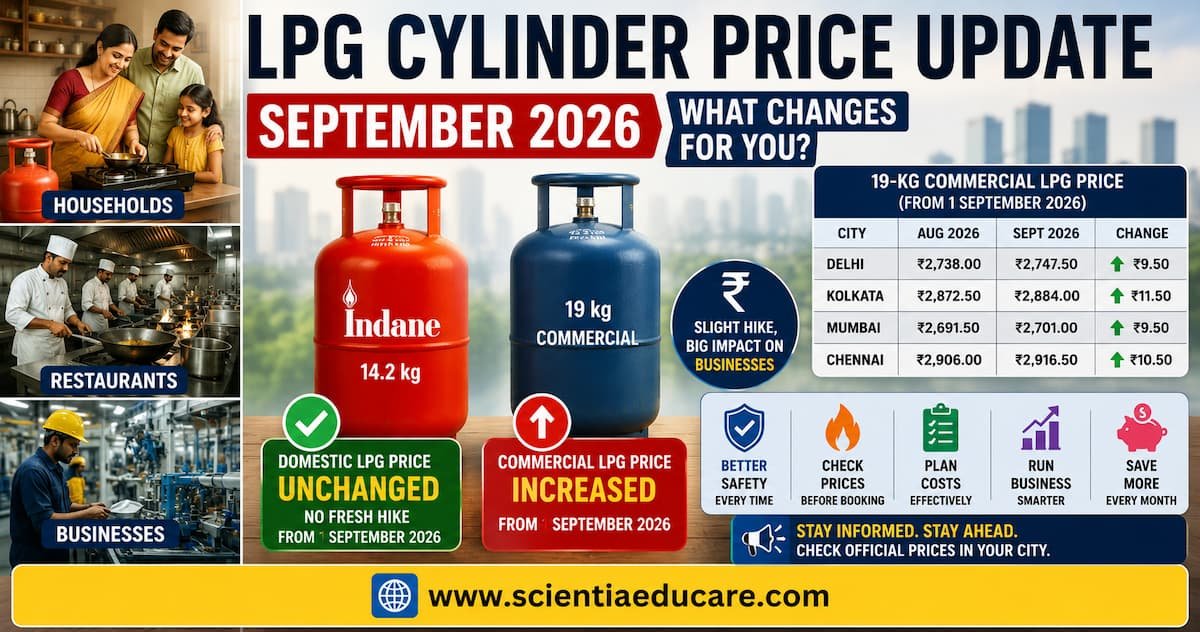
LPG Cylinder Price Update September 2026: What Changes for Households, Restaurants and Businesses?
LPG cylinder prices have been revised from 1 September 2026, bringing relief for households but a modest increase in costs for restaurants, hotels and other commercial users.
Oil marketing companies have increased the price of 19-kg commercial LPG cylinders, while the price of the standard 14.2-kg domestic LPG cylinder has been kept unchanged.
In Delhi, a 19-kg commercial LPG cylinder now costs ₹2,747.50, up ₹9.50 from ₹2,738. Commercial LPG prices have also increased in Mumbai, Kolkata, Chennai and several other cities.
For households, however, there is no fresh increase in September.
The 14.2-kg domestic LPG cylinder continues to cost ₹942 in Delhi, with prices varying between cities.
So, what does the September LPG price revision actually mean for households, restaurants, hotels, caterers and small businesses?
Let’s take a closer look.
LPG Price September 2026: What Changed?
The latest LPG price revision became effective on 1 September 2026.
The most important changes are:
Domestic LPG: No change
19-kg Commercial LPG: Price increased
5-kg FTL non-domestic LPG: Price increased by ₹2
The price of the 5-kg market-priced Free Trade LPG cylinder has increased from ₹762 to ₹764.
The September commercial LPG increase follows two consecutive monthly reductions in July and August.
This means businesses received substantial relief during the previous two months before seeing a relatively small upward adjustment in September.
Commercial LPG Price September 2026: City-Wise Rates
Commercial LPG prices vary from city to city because of factors including local taxation and distribution costs.
The revised prices of 19-kg commercial LPG cylinders in major cities include:
| City | September 2026 Price | Increase |
|---|---|---|
| Delhi | ₹2,747.50 | ₹9.50 |
| Mumbai | ₹2,701.00 | ₹9.50 |
| Kolkata | ₹2,884.00 | ₹11.50 |
| Chennai | ₹2,916.50 | ₹10.50 |
| Bengaluru | ₹2,831.00 | ₹10.00 |
| Hyderabad | ₹2,996.00 | ₹11.00 |
| Bhubaneswar | ₹2,919.00 | ₹11.00 |
| Jaipur | ₹2,776.00 | ₹10.50 |
| Lucknow | ₹2,870.00 | ₹9.50 |
| Patna | ₹3,029.00 | ₹11.00 |
The official Indian Oil price page confirms the September 1 commercial rates of ₹2,747.50 in Delhi, ₹2,884 in Kolkata, ₹2,701 in Mumbai and ₹2,916.50 in Chennai.
Consumers should remember that LPG prices can vary by location, so the amount payable in a particular city or district may differ from these metro rates.
Domestic LPG Price September 2026: No Fresh Increase for Households
The biggest relief in the September revision is for household consumers.
There has been no increase in the price of the 14.2-kg domestic LPG cylinder from September 1.
Indian Oil currently lists the non-subsidised 14.2-kg Indane cylinder prices in the four metros as:
| City | Domestic LPG Price |
|---|---|
| Delhi | ₹942.00 |
| Kolkata | ₹968.00 |
| Mumbai | ₹941.50 |
| Chennai | ₹957.50 |
Indian Oil’s published domestic rates were last updated following the June 2026 revision.
For households already managing food, electricity, education, transport and other expenses, the absence of another LPG increase in September provides some relief.
When Was Domestic LPG Last Increased?
Domestic LPG prices were last increased on 7 June 2026, when the price rose by ₹29 per 14.2-kg cylinder.
That followed an earlier increase of ₹60 in March amid sharp disruptions in global energy markets linked to the West Asia conflict.
In Delhi, the price consequently moved from:
₹853 before the March increase
to
₹913 after the March increase
and then to
₹942 following the June increase.
The September decision therefore keeps domestic prices stable after households experienced significant increases earlier in the year.
What Does the September LPG Update Mean for Households?
For most households, the immediate answer is simple:
Your domestic LPG cylinder has not become more expensive because of the September 1 revision.
If a family normally uses one 14.2-kg domestic cylinder every month, there is no additional monthly LPG expense resulting specifically from the September revision.
This matters because cooking fuel forms part of the regular household budget.
A rise in domestic LPG prices can directly affect millions of families.
According to government information, India has more than 33 crore domestic LPG consumers, compared with a much smaller number of commercial LPG users.
Therefore, keeping household LPG unchanged has a much broader direct consumer impact than the commercial-cylinder adjustment.
Does This Mean Household Cooking Costs Will Not Rise?
Not necessarily.
Domestic LPG prices are only one component of household food expenses.
Families can still experience higher costs because of changes in:
- Vegetables
- Cooking oil
- Milk
- Cereals
- Pulses
- Electricity
- Transportation
- Other essential commodities
Therefore, unchanged LPG prices do not guarantee that the overall kitchen budget will remain unchanged.
But they do mean households are not facing an additional LPG-cylinder price increase in September.
Restaurants Face Higher Commercial LPG Costs
Restaurants are among the businesses most directly affected by the September LPG revision.
Commercial kitchens can use significant quantities of LPG every month.
The impact depends on:
- Restaurant size
- Number of cylinders consumed
- Type of food prepared
- Operating hours
- Number of outlets
- Alternative fuels available
- Existing profit margins
For a small restaurant using 10 commercial cylinders per month, a ₹10 increase per cylinder would add approximately:
₹10 × 10 = ₹100 per month
to LPG expenses.
For a restaurant using 100 cylinders:
₹10 × 100 = ₹1,000 per month
The September increase alone is therefore relatively modest.
However, LPG prices can change substantially over time, making fuel-price volatility a more important concern than any single month’s ₹10 increase.
Why the Bigger LPG Price Trend Matters More
Looking only at September’s ₹9.50 increase can be misleading.
Commercial LPG prices experienced extraordinary volatility earlier in 2026.
According to the latest reported pricing data, a 19-kg commercial LPG cylinder in Delhi increased from approximately ₹1,740.50 in February to ₹3,113.50 in June amid the West Asia crisis.
That represented an increase of approximately ₹1,373 per cylinder.
Commercial LPG prices subsequently fell sharply.
The Delhi price was reduced by approximately:
₹183.50 on July 1
and another
₹192 on August 1.
The September ₹9.50 increase therefore comes after two substantial reductions.
This context is important.
Businesses are not simply dealing with a ₹9.50 September increase—they are operating in an environment where energy costs have been unusually volatile.
What Does This Mean for Hotels?
Hotels use LPG for a variety of purposes, particularly:
- Restaurant kitchens
- Banquet operations
- Catering
- Staff kitchens
- Food preparation
- Other applicable heating requirements
A small increase per cylinder may have limited immediate impact on a large hotel.
However, large properties can consume substantial quantities of LPG.
Repeated monthly increases can therefore affect operating costs.
Hotels may respond by focusing on:
- Energy efficiency
- Kitchen efficiency
- Menu costing
- Supplier negotiations
- Alternative energy sources
- Waste reduction
The impact becomes more significant when LPG increases occur alongside higher costs for food, labour, electricity and transportation.
What Does This Mean for Small Food Businesses?
Small food businesses may be more sensitive to LPG price changes than large restaurant chains.
These can include:
- Small restaurants
- Dhabas
- Bakeries
- Tea shops
- Sweet shops
- Street-food businesses using commercial LPG
- Cloud kitchens
- Cafeterias
- Canteens
- Catering businesses
Many small businesses operate with relatively narrow profit margins.
They may therefore find it harder to absorb repeated increases in:
LPG + vegetables + edible oil + rent + wages + electricity
without eventually adjusting menu prices.
The September LPG increase by itself is unlikely to cause a dramatic increase in food prices.
But repeated cost increases can accumulate.
Could Restaurant Food Prices Increase?
Possibly, but consumers should not expect every restaurant to immediately increase prices because of a ₹9.50–₹11.50 rise in commercial LPG.
Restaurants consider their total operating costs, not LPG alone.
Menu prices can depend on:
- Food ingredients
- Cooking fuel
- Rent
- Salaries
- Electricity
- Packaging
- Delivery commissions
- Transportation
- Taxes
- Profit margins
A modest LPG increase can usually be absorbed by many businesses.
However, if fuel prices continue rising over several months, businesses may eventually pass some of the additional costs to customers.
This is particularly relevant during periods when food prices are also increasing.
Bakeries Could Also Feel the Impact
Bakeries and food-production businesses can be heavy users of commercial cooking fuel.
LPG may be used for:
- Baking
- Heating
- Cooking
- Food processing
- Commercial ovens
For a bakery producing goods throughout the day, fuel is an important input cost.
Higher LPG expenses can therefore affect the cost of:
- Bread
- Cakes
- Biscuits
- Snacks
- Bakery products
Again, the September increase itself is relatively small, but persistent increases could eventually affect product pricing.
Catering Businesses May Face Higher Event Costs
Caterers can consume multiple commercial LPG cylinders during weddings, festivals, corporate functions and large events.
This makes them particularly exposed to changes in commercial LPG prices.
For catering companies, fuel costs form part of a larger cost structure that also includes:
- Ingredients
- Labour
- Transportation
- Equipment
- Venue logistics
- Serving materials
A higher commercial LPG price can therefore slightly increase the cost of delivering large events.
Businesses may absorb small changes but revise quotations if energy costs increase significantly over time.
Why Are Commercial LPG Prices Changing?
Commercial LPG prices are linked to several economic factors.
One of the most important is the movement of international LPG benchmark prices.
Other factors include:
- Global crude and energy prices
- International LPG prices
- Rupee-dollar exchange rate
- Shipping costs
- Insurance costs
- Supply conditions
- Geopolitical tensions
- Local taxes
The September increase was implemented in line with changes in international benchmark prices.
This is why commercial LPG prices can move up or down from one month to another.
Why Has LPG Been So Volatile in 2026?
The global energy market has faced significant disruption in 2026.
West Asia tensions affected energy supplies, shipping and international LPG prices earlier in the year.
CRISIL Intelligence reported that the Saudi Aramco Contract Price—a key benchmark for India’s LPG imports—increased approximately 46% between February and June 2026 as markets priced in supply disruption and higher freight costs.
This helps explain why commercial LPG prices rose so sharply earlier in the year.
As market conditions subsequently improved, prices were reduced in July and August.
September’s increase indicates that commercial LPG remains sensitive to global energy-market conditions.
India’s Dependence on LPG Imports Matters
India is a major LPG consumer, and imported supplies play an important role in meeting demand.
When international LPG prices increase or shipping routes are disrupted, domestic pricing can come under pressure.
This means events thousands of kilometres away can ultimately affect the price paid by:
Restaurants → hotels → caterers → bakeries → other LPG-dependent businesses
The government and energy companies have therefore been focusing on strengthening domestic LPG production and energy security.
Why Domestic and Commercial LPG Prices Can Move Differently
Consumers sometimes ask:
“If commercial LPG has become costlier, why hasn’t domestic LPG also increased?”
The two categories do not necessarily follow identical pricing patterns.
Commercial LPG prices more directly reflect international market movements and are revised periodically.
Domestic LPG pricing also involves government policy considerations because cooking gas is an essential household fuel used by hundreds of millions of consumers.
Government data has previously highlighted the significant difference in scale: there are over 33 crore domestic LPG consumers, compared with around 30 lakh commercial LPG users in the public-sector company network.
This helps explain why household LPG pricing has major social and economic implications.
What About PMUY Beneficiaries?
Pradhan Mantri Ujjwala Yojana (PMUY) is designed to provide cleaner cooking fuel access to eligible households.
PMUY beneficiaries may receive applicable government support or subsidy subject to the prevailing scheme rules and eligibility conditions.
Consumers should distinguish between:
Retail LPG cylinder price
and
effective cost after any applicable subsidy or benefit.
The amount ultimately borne by an eligible beneficiary can therefore differ from the headline retail price.
Consumers should check their LPG account and official government or oil-company information for the latest applicable subsidy rather than relying on unofficial social-media messages.
How Often Are LPG Prices Revised?
Commercial LPG prices are generally reviewed at the beginning of each month.
This is why businesses often monitor the first day of the month for new LPG rates.
The September revision became effective on 1 September 2026.
The next commercial LPG revision would ordinarily be watched at the beginning of October, subject to the prevailing pricing process.
For businesses that consume large quantities of LPG, monthly price monitoring can therefore be useful for budgeting.
How Much Extra Will Businesses Actually Pay?
The easiest way to calculate the impact is:
Monthly LPG cylinders used × price increase per cylinder = additional monthly cost
For example, assuming an average increase of ₹10:
| Monthly Cylinders | Approx. Extra Cost |
|---|---|
| 10 | ₹100 |
| 25 | ₹250 |
| 50 | ₹500 |
| 100 | ₹1,000 |
| 250 | ₹2,500 |
| 500 | ₹5,000 |
This illustrates why the impact differs enormously depending on the scale of the business.
For a small café, the difference may be minor.
For a large restaurant chain with many outlets, the cumulative effect can be considerably larger.
Should Restaurants Immediately Raise Menu Prices?
Not necessarily.
Businesses should first assess the actual impact on their total costs.
Suppose a restaurant’s monthly expenses are several lakh rupees and its LPG cost increases by ₹500.
Increasing every menu item may not be necessary.
A better approach is to examine:
Food cost + fuel cost + labour + rent + utilities + delivery costs + margins
before changing prices.
Consumers are price-sensitive, so unnecessary menu increases can reduce demand.
How Businesses Can Reduce LPG Consumption
Energy efficiency can help restaurants and commercial kitchens reduce their exposure to LPG price fluctuations.
1. Maintain Burners Properly
Poorly maintained burners can waste fuel.
2. Use Appropriate Cookware
Correct vessel sizes and good-quality cookware can improve heat transfer.
3. Cover Cooking Vessels
Using lids can reduce cooking time and fuel consumption.
4. Plan Batch Cooking
Preparing food efficiently can reduce repeated heating.
5. Reduce Idle Burner Time
Leaving burners running unnecessarily wastes LPG.
6. Maintain Kitchen Equipment
Regular maintenance can improve efficiency.
7. Monitor Cylinder Consumption
Businesses should track LPG consumption per day, meal or unit of production.
What gets measured can often be improved.
Households Can Also Improve LPG Efficiency
Even though domestic LPG prices are unchanged in September, reducing consumption can still save money.
Simple measures include:
- Using pressure cookers where appropriate
- Keeping vessels covered
- Soaking pulses before cooking
- Using the correct flame size
- Keeping burners clean
- Preparing ingredients before lighting the stove
- Avoiding unnecessary reheating
- Checking for safe and efficient appliance operation
Small savings can accumulate over an entire year.
Safety, however, should always take priority over fuel-saving techniques.
LPG Safety Remains Essential
Price changes often receive the most attention, but safe LPG usage is more important.
Consumers should:
- Use authorised LPG connections
- Keep cylinders upright
- Ensure proper ventilation
- Check regulators and hoses
- Avoid placing flammable materials near the stove
- Turn off the regulator when appropriate
- Never test suspected leaks with a flame
- Contact the authorised distributor or emergency service if a leak is suspected
Commercial kitchens should also follow applicable fire-safety and storage requirements.
Beware of Fake LPG Price and Subsidy Messages
Whenever LPG prices change, misleading messages can spread through WhatsApp, Facebook and other social-media platforms.
Consumers may encounter claims such as:
- “₹500 LPG cylinder for everyone”
- “New subsidy automatically credited”
- “Complete this link to receive LPG benefit”
- “Your gas connection will be cancelled today”
Such messages should not automatically be trusted.
Consumers should verify information through:
- Official oil-company websites
- Government portals
- Authorised LPG distributors
- Official government announcements
Never provide OTPs, banking credentials or Aadhaar information through suspicious links.
What Does the September LPG Revision Mean for Inflation?
Domestic LPG has a more direct impact on household budgets.
Because domestic cylinder prices have not increased in September, the latest revision does not impose a fresh direct cooking-gas burden on household LPG users.
Commercial LPG is different.
Higher commercial LPG costs can indirectly influence the cost structure of:
- Restaurants
- Hotels
- Bakeries
- Caterers
- Food-service businesses
However, the September increase is relatively small compared with the much larger price movements earlier in 2026.
Its immediate inflationary impact is therefore likely to be more limited than a major domestic LPG hike would have been.
What Businesses Should Watch Next
Businesses dependent on LPG should monitor several factors over the coming months.
International Energy Prices
Higher global prices could put further pressure on LPG.
West Asia Developments
Geopolitical disruptions can affect energy supplies and shipping.
Rupee-Dollar Exchange Rate
A weaker rupee can make imported energy more expensive.
Freight Costs
Shipping and insurance costs can affect imported LPG prices.
Monthly OMC Revisions
The first-of-the-month commercial LPG revision remains particularly important for restaurants and hospitality businesses.
September LPG Price Update: Who Gains and Who Pays More?
The impact can be summarised simply.
Households
No fresh increase.
The 14.2-kg domestic cylinder price remains unchanged.
Restaurants
Slightly higher fuel costs.
Commercial cylinders have become ₹9.50–₹11.50 more expensive across the major cities listed.
Hotels
Higher commercial kitchen expenses, although the September increase itself is modest.
Caterers
Slight increase in event cooking costs, particularly for high-volume operations.
Bakeries
Higher fuel input costs where commercial LPG is heavily used.
Small Businesses
The impact depends on cylinder consumption and the ability to absorb higher costs.
The Bigger Picture
September’s LPG revision illustrates an important reality about India’s energy economy.
Households and businesses can experience very different price movements.
Domestic LPG has been kept unchanged this month, protecting household consumers from another immediate increase.
Commercial users, however, remain more directly exposed to international energy-market fluctuations.
The September increase is small compared with the dramatic movements earlier this year.
But the broader lesson for businesses is clear:
Energy-price volatility has become an important operating risk.
Restaurants, hotels and other LPG-dependent businesses should therefore focus not only on the current cylinder price but also on improving energy efficiency and managing costs over the long term.
Conclusion
The September 2026 LPG price update brings mixed news for Indian consumers and businesses.
For households, there is relief.
The price of the standard 14.2-kg domestic LPG cylinder remains unchanged, with Indian Oil listing the current price at ₹942 in Delhi, ₹968 in Kolkata, ₹941.50 in Mumbai and ₹957.50 in Chennai.
For commercial users, however, LPG has become slightly more expensive.
A 19-kg commercial LPG cylinder now costs ₹2,747.50 in Delhi, ₹2,884 in Kolkata, ₹2,701 in Mumbai and ₹2,916.50 in Chennai.
The increase ranges from approximately ₹9.50 to ₹11.50 across several major cities.
Restaurants, hotels, bakeries, caterers and other commercial users will therefore face a modest increase in operating costs.
But context matters.
Commercial LPG prices were cut substantially in both July and August following the extraordinary increases seen earlier in the year. September’s adjustment is therefore much smaller than the price swings businesses experienced during the previous months.
For households, the message is simple:
No new LPG price increase in September.
For businesses, the message is slightly different:
Commercial LPG is costlier—but efficient fuel management may matter more than this month’s relatively small increase.
And for everyone, the coming months will depend heavily on global energy prices, geopolitical developments, exchange rates and international LPG supply conditions.
Frequently Asked Questions (FAQs)
1. Has LPG cylinder price increased in September 2026?
Commercial LPG prices have increased from 1 September 2026, while domestic LPG prices remain unchanged.
2. What is the price of a domestic LPG cylinder in Delhi in September 2026?
A 14.2-kg non-subsidised Indane LPG cylinder is listed at ₹942 in Delhi.
3. What is the commercial LPG price in Delhi?
A 19-kg commercial LPG cylinder costs ₹2,747.50 in Delhi from September 1, up ₹9.50.
4. What is the commercial LPG price in Kolkata?
The 19-kg commercial LPG cylinder costs ₹2,884 in Kolkata.
5. What is the commercial LPG price in Mumbai?
The September 2026 price of a 19-kg commercial LPG cylinder in Mumbai is ₹2,701.
6. What is the commercial LPG price in Chennai?
A 19-kg commercial LPG cylinder costs ₹2,916.50 in Chennai.
7. Will restaurants become more expensive because of the LPG hike?
The September increase raises restaurant fuel costs slightly, but whether menu prices change depends on total operating costs, competition and individual business decisions.
8. Why do commercial LPG prices change every month?
Commercial LPG prices are influenced by international benchmark prices, exchange rates, supply conditions and other market factors.
9. Did commercial LPG prices fall before the September increase?
Yes. Commercial LPG prices were reduced substantially in July and August 2026 before the September increase.
10. Where can consumers check official LPG prices?
Consumers can check current Indane LPG prices and related information through Indian Oil’s official website:
Indian Oil — Indane LPG Prices
- LPG price today India
- LPG price September 2026
- commercial LPG price September 2026
- domestic LPG cylinder price
- 19 kg LPG cylinder price
- LPG price hike September 2026
- commercial gas cylinder price
- LPG cylinder price Delhi
- LPG cylinder price Mumbai
- LPG cylinder price Kolkata
- LPG cylinder price Chennai
- restaurant LPG price
- cooking gas price India
- LPG price latest update