

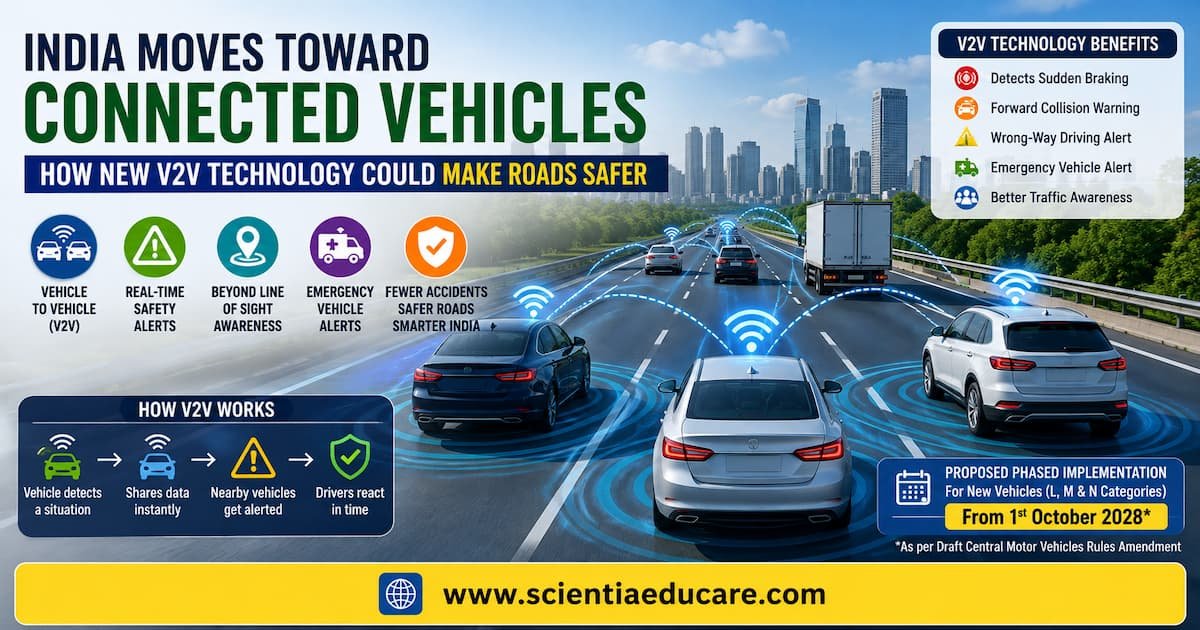
India Moves Toward Connected Vehicles: How New V2V Technology Could Make Roads Safer
Imagine driving on a highway when a vehicle several cars ahead suddenly brakes.
You cannot see the vehicle because a large truck is blocking your view. Before you have time to react, your car receives a wireless warning telling you that a sudden braking event has occurred ahead.
That is the basic idea behind Vehicle-to-Vehicle (V2V) communication.
India is now moving toward this connected-vehicle future. The Ministry of Road Transport and Highways (MoRTH) has proposed a phased framework for introducing V2V communication systems in motor vehicles through draft amendments to the Central Motor Vehicles Rules, 1989.
Under the proposal, new vehicles in categories L, M and N manufactured from 1 October 2028 would be required to have V2V communication systems conforming to AIS-230. Vehicles equipped with V2V systems from 1 October 2027 would have to comply with the standard during the transition period.
The move could mark an important step in India’s transition from conventional vehicles to connected and intelligent mobility.
But how exactly does V2V work? Can cars really “talk” to one another? And could this technology actually reduce road accidents in India?
Let’s understand.
What Is V2V Technology?
V2V stands for Vehicle-to-Vehicle communication.
It allows nearby vehicles equipped with compatible communication systems to exchange information wirelessly in real time.
This information can include:
- Vehicle speed
- Position
- Direction
- Acceleration
- Braking status
- Other safety-related information
A vehicle can use this information to identify potentially dangerous situations and provide an alert to the driver or connected vehicle system.
In simple terms:
Instead of every vehicle relying only on what its own sensors can see, vehicles can share information about what is happening around them.
This creates a much wider picture of the road environment.
Why Does India Need Connected Vehicle Technology?
India has made major investments in highways, expressways and transportation infrastructure.
But road safety remains a major challenge.
Government figures have previously indicated that India records roughly 1.8 lakh road fatalities annually. In 2024, India recorded approximately 4.73 lakh road accidents and 1.70 lakh deaths, according to figures cited in a parliamentary report.
The government has therefore been pursuing multiple approaches to improve road safety, including:
- Better road engineering
- Enforcement
- Emergency response
- Intelligent transportation systems
- Advanced traffic management
- Technology-based monitoring
- Driver awareness
- Vehicle safety systems
V2V is intended to become another layer in this broader road-safety strategy.
How Does V2V Communication Work?
The technology relies on an On-Board Unit (OBU) installed in the vehicle.
The OBU allows vehicles to communicate wirelessly with one another using the designated communication technology and spectrum.
India’s proposed AIS-230 framework specifies Cellular Vehicle-to-Everything (C-V2X) technology for factory-installed V2V systems. The relevant frequency range is 5.875 GHz to 5.925 GHz.
A simplified process looks like this:
Vehicle A detects sudden braking
↓
Vehicle A transmits safety information
↓
Nearby connected vehicles receive the information
↓
Vehicle B identifies a potential collision risk
↓
Driver receives an advance warning
↓
Driver has more time to react
The system could potentially operate even when the dangerous vehicle is not directly visible.
The Biggest Advantage: Beyond the Driver’s Line of Sight
Traditional vehicle safety systems often depend on sensors and cameras that detect objects within their field of view.
V2V can provide information beyond that direct line of sight.
For example, consider a highway situation:
You → Large truck → Vehicle braking suddenly
Your camera may see only the truck.
But if the vehicle beyond the truck is connected through V2V, it could transmit information about sudden braking.
Your vehicle could therefore receive a warning before your own sensors can visually detect the danger.
This is one of the most important potential advantages of V2V.
The technology is designed to complement existing safety systems such as Advanced Driver Assistance Systems (ADAS) rather than replace them.
What Safety Problems Could V2V Help Address?
India’s proposed AIS-230 framework identifies several road-safety applications for V2V technology.
These include:
1. Emergency Brake Alert
If a vehicle suddenly brakes, nearby connected vehicles can receive an alert.
This could give following drivers additional reaction time.
2. Forward Collision Warning
The system can help identify situations where two vehicles may be approaching a collision.
3. Wrong-Way Driving
If a vehicle is travelling in the wrong direction, connected vehicles could potentially receive a warning.
4. Emergency Vehicle Alert
Vehicles can be alerted to the approach of emergency vehicles, potentially helping drivers make way for ambulances, fire engines or other emergency responders.
These applications could become particularly valuable in dense urban traffic and on high-speed highways.
V2V vs ADAS: What Is the Difference?
V2V and ADAS are related but different technologies.
ADAS
Advanced Driver Assistance Systems can use:
- Cameras
- Radar
- LiDAR in some systems
- Ultrasonic sensors
- GPS and other sensors
to detect objects and road conditions around a vehicle.
V2V
V2V allows vehicles to share information directly with one another.
The difference can be simplified as:
ADAS:
“What can my vehicle detect?”
V2V:
“What are other connected vehicles telling me about what is happening around them?”
Combining both approaches could provide a more comprehensive safety picture.
What Is C-V2X?
India’s proposed AIS-230 standard is based on Cellular Vehicle-to-Everything, or C-V2X technology.
The term “V2X” is broader than V2V.
It can include communication between vehicles and:
- Other vehicles — V2V
- Infrastructure — V2I
- Pedestrians — V2P
- Networks — V2N
Together, these technologies form part of the broader concept of connected mobility.
India’s telecom regulator, TRAI, also released a consultation paper in April 2026 on the regulatory framework for V2X communication. The consultation was requested by the Department of Telecommunications as part of work on the regulatory framework for vehicle connectivity.
This shows that India’s connected-vehicle transition involves not only the automotive sector but also the telecommunications and regulatory ecosystem.
India’s Proposed V2V Timeline
One of the most important details for consumers and vehicle manufacturers is the proposed implementation timeline.
From 1 October 2027
Vehicles in categories L, M and N that are equipped with V2V communication systems would have to comply with AIS-230 under the proposed framework.
From 1 October 2028
Vehicles in categories L, M and N manufactured from this date would be required to have V2V communication systems conforming to AIS-230.
Important clarification
These dates come from the draft notification.
The government has stated that comments and suggestions on the draft rules would be examined before the final notification is issued.
Therefore, consumers should understand the difference between:
Proposed framework → final rules → actual implementation
The current development represents a major policy move toward connected vehicles, but the final regulatory position can change before implementation.
Which Vehicles Could Be Covered?
The proposed framework refers to vehicle categories L, M and N.
Broadly, these categories cover different types of motor vehicles, including:
- Two-wheelers and three-wheelers in relevant L categories
- Passenger vehicles in M categories
- Goods and certain commercial vehicles in N categories
The exact applicability depends on the vehicle classification and final regulatory requirements.
This is important because V2V should not be viewed simply as a technology for expensive premium cars.
If implemented as proposed, the framework could eventually extend connected safety technology across a much broader range of new vehicles.
Could V2V Make Indian Roads Safer?
Potentially, yes.
But it is important not to present V2V as a magic solution.
The technology could improve situational awareness and provide earlier warnings.
That could be particularly valuable in situations involving:
- Sudden braking
- Blind corners
- Highway congestion
- Wrong-way vehicles
- Emergency vehicles
- Obstructed visibility
- Multi-vehicle traffic
However, the effectiveness of V2V will depend on several factors.
The Network Effect: Why Adoption Matters
V2V becomes more useful as more vehicles have the technology.
Imagine a road with 1,000 vehicles.
If only five vehicles have V2V, the system’s benefits are limited.
If 500 vehicles are connected, the amount of shared road information becomes much greater.
Eventually, if most new vehicles are equipped with compatible systems, V2V could become a significant layer of road safety.
This is known as a network effect.
The more compatible vehicles participate, the more useful the system can become.
What About Older Vehicles?
This is one of the practical challenges.
India has a very large vehicle population, and millions of vehicles already on the road will not automatically acquire factory-installed V2V systems.
Therefore, even if new vehicles become connected, the road environment will remain mixed for many years.
You could have:
Connected car + connected bus + connected truck + older motorcycle + older car
all sharing the same road.
This means V2V should be treated as a gradual transition, not an overnight transformation.
Will Every Vehicle Need Internet Connectivity?
Not necessarily in the way people normally think of internet access.
V2V communication involves direct wireless communication between compatible vehicles, while the broader V2X ecosystem can also involve network and infrastructure communication.
The proposed Indian framework specifically refers to C-V2X and factory-installed On-Board Units.
This distinction matters because safety-critical communication needs to be designed around reliability and low-latency communication rather than simply relying on ordinary mobile internet applications.
What Does the On-Board Unit Do?
The On-Board Unit (OBU) is essentially the communication hardware installed in the vehicle.
It can:
- Receive information from nearby vehicles
- Transmit the vehicle’s own safety information
- Process communication messages
- Work with positioning systems
- Generate safety alerts
- Support connected-vehicle applications
The AIS-230 framework includes requirements relating to radio performance, positioning, electrical systems, electromagnetic compatibility, cybersecurity and safety applications.
In other words, this is not simply a small Bluetooth-style gadget.
It needs to meet automotive-grade technical and safety requirements.
How Much Could V2V Systems Cost?
The cost of connected-vehicle hardware will depend on the final specifications, manufacturing scale and integration approach.
Some recent reporting has estimated the cost of an On-Board Unit at around ₹5,000–₹7,000, but this should be treated as an industry estimate rather than a final government-fixed consumer price.
Mass production could potentially reduce costs over time.
For consumers, the most important issue will ultimately be whether the technology is:
Affordable + reliable + secure + effective
What Does V2V Mean for Car Buyers?
If the proposed framework proceeds, connected safety technology could become increasingly common in new vehicles.
For consumers, this could eventually mean:
- More safety alerts
- Better awareness of nearby traffic
- Earlier warnings about collisions
- Better emergency-vehicle awareness
- Greater integration with ADAS
- More connected mobility features
However, buyers should not assume that a vehicle with V2V is automatically “accident-proof.”
Human behaviour will remain extremely important.
V2V Cannot Replace Safe Driving
This is perhaps the most important point.
A connected vehicle can warn a driver.
It cannot guarantee that the driver will respond correctly.
Speeding, distracted driving, drunk driving, dangerous overtaking, helmet non-use and other risky behaviour remain major road-safety concerns.
Technology should therefore be viewed as an additional safety layer.
A useful model is:
Safe road design + enforcement + responsible driving + vehicle safety + connected technology + emergency response
rather than technology alone.
V2V and Two-Wheeler Safety
Two-wheelers are especially important in India’s road-safety discussion.
Government messaging has indicated that roughly 45% of road fatalities involve two-wheelers.
That makes the inclusion of relevant L-category vehicles particularly significant.
If connected safety systems become affordable and widely deployed on motorcycles and scooters, V2V could potentially help riders receive warnings about:
- Sudden braking
- Nearby collision risks
- Wrong-way traffic
- Emergency vehicles
- Dangerous traffic situations
However, two-wheelers also present unique technical challenges, including device size, power requirements, rider behaviour and affordability.
What Does V2V Mean for Trucks and Commercial Vehicles?
Commercial vehicles could become major beneficiaries of connected safety technology.
Large trucks create significant blind spots for other road users.
V2V communication could help improve awareness around:
- Heavy vehicles
- Sudden braking
- Lane changes
- Emergency situations
- Traffic congestion
For fleet operators, connected vehicles could eventually provide additional opportunities for:
- Fleet safety management
- Route optimisation
- Incident monitoring
- Driver assistance
- Predictive maintenance
- Logistics efficiency
This means the benefits could extend beyond individual drivers to the wider transport economy.
V2V Could Help Emergency Vehicles Reach Faster
One interesting proposed safety application is the Emergency Vehicle Alert.
Imagine an ambulance travelling rapidly through congested traffic.
Connected vehicles ahead could receive an alert indicating that an emergency vehicle is approaching.
Drivers could then be encouraged to create a path.
This could potentially improve emergency response times, although the actual effectiveness would depend on system deployment, driver behaviour, traffic conditions and integration with emergency services.
In a country where timely emergency care can make a major difference, even small improvements in response time could matter.
India’s PM RAHAT road-accident treatment programme is already using technology and emergency-response integration to improve access to timely care after crashes.
V2V could eventually complement such emergency-response systems from the pre-crash and traffic-management side.
V2V and Smart Highways
Connected vehicles could become even more powerful when combined with intelligent road infrastructure.
For example:
Vehicle → Vehicle
Vehicle → Traffic signal
Vehicle → Roadside unit
Vehicle → Traffic management centre
Vehicle → Emergency services
This is where V2V can evolve into the broader V2X ecosystem.
India is already deploying intelligent traffic-management technologies on highways, including AI-based video incident detection, automatic number-plate recognition and surveillance systems.
Combining vehicle connectivity with intelligent infrastructure could eventually create a more responsive transportation network.
Cybersecurity: The Biggest New Challenge
Connected vehicles also create new risks.
If vehicles are communicating with one another, the communication system must be secure.
Potential threats could include:
- Fake safety messages
- Vehicle impersonation
- Data manipulation
- Cyberattacks
- Location-data misuse
- Unauthorised access
- Communication disruption
India’s proposed AIS-230 framework explicitly includes cybersecurity and communication-security provisions.
This is essential.
A technology designed to prevent accidents could become dangerous if malicious actors can manipulate the information it receives.
Privacy Concerns
V2V systems may involve information related to a vehicle’s:
- Location
- Movement
- Direction
- Speed
- Communication identity
This creates legitimate privacy questions.
Consumers may want to know:
Who can access the data?
How long is it stored?
Can it be used for enforcement?
Can companies use it for commercial purposes?
How is personal information protected?
As connected mobility expands, India’s regulatory framework will need to balance road safety, innovation, cybersecurity and privacy.
Can V2V Messages Be Wrong?
Yes.
Like any technology system, V2V will not be perfect.
Possible problems could include:
- Communication failure
- GPS inaccuracies
- Hardware failure
- Incorrect information
- Network interference
- Cybersecurity incidents
- Compatibility issues
This is why V2V should not operate as the sole basis for critical driving decisions.
Instead, it should complement:
- Driver judgment
- Vehicle sensors
- ADAS
- Road infrastructure
- Traffic signals
- Other safety systems
Why Standardisation Is So Important
Imagine one car using one communication standard and another car using a completely different system.
They may not be able to communicate effectively.
That is why common standards such as AIS-230 are important.
The proposed Indian framework sets technical requirements relating to:
- Radio performance
- Frequency stability
- Receiver sensitivity
- GNSS positioning
- Electrical systems
- Electromagnetic compatibility
- Cybersecurity
- Safety applications
Standardisation can help ensure that vehicles from different manufacturers can communicate reliably.
What Could V2V Mean for India’s Auto Industry?
The move could create a new technology ecosystem involving:
- Automobile manufacturers
- Automotive suppliers
- Semiconductor companies
- Telecom operators
- Software developers
- Cybersecurity companies
- Mapping companies
- Testing agencies
- Road infrastructure providers
- Government regulators
As vehicles become software-defined and connected, the automotive industry is increasingly becoming a combination of:
Automobile engineering + electronics + software + telecommunications + AI + cybersecurity
This could create new opportunities for India’s technology and manufacturing sectors.
Opportunities for Indian Technology Companies
The connected-vehicle transition could create demand for:
Automotive Software
Software platforms that manage connected-vehicle communication.
Cybersecurity
Systems that protect vehicle-to-vehicle communication.
Mapping and Location Services
High-precision positioning and digital maps.
AI and Analytics
Systems that analyse traffic and identify safety risks.
Cloud Platforms
Infrastructure supporting connected mobility services.
Embedded Systems
Hardware and software for vehicle communication.
Testing and Certification
Specialised services for ensuring compliance with automotive standards.
This could become an important emerging technology market.
What Does This Mean for India’s EV Future?
Electric vehicles and connected vehicles are separate concepts, but they can work together.
An EV can be:
Electric + Connected + Software-defined + AI-enabled
The increasing adoption of EVs may therefore accelerate the integration of advanced digital systems into vehicles.
But V2V is not an EV-only technology.
Petrol, diesel, hybrid, electric and other compatible vehicles could participate if they meet the applicable requirements.
The key factor is communication capability, not the type of propulsion system.
India Is Moving Toward Software-Defined Vehicles
Modern vehicles are increasingly becoming computers on wheels.
Software can control or influence:
- Driver assistance
- Infotainment
- Battery management
- Vehicle diagnostics
- Navigation
- Safety systems
- Connectivity
- Over-the-air updates
V2V adds another layer:
Vehicles can communicate not only with their own internal systems but also with other vehicles around them.
This is a fundamental shift in how road transportation can operate.
What Could Indian Roads Look Like in the Future?
Imagine a future highway where:
A car detects sudden braking.
↓
Nearby vehicles receive the warning.
↓
A truck receives a collision-risk alert.
↓
An ambulance approaching from behind transmits an emergency-vehicle alert.
↓
Traffic infrastructure detects congestion.
↓
Roadside systems communicate with vehicles.
↓
A traffic management centre receives real-time information.
↓
Drivers receive safety recommendations.
This is the broader vision of connected mobility.
V2V is only one part of that ecosystem.
The Challenges India Must Solve
Despite the potential benefits, implementation will not be easy.
1. High Vehicle Diversity
India has an enormous mix of cars, motorcycles, trucks, buses and older vehicles.
2. Cost
Connected hardware must remain affordable.
3. Coverage
The system must work reliably across different road environments.
4. Interoperability
Vehicles from different manufacturers must communicate effectively.
5. Cybersecurity
The system must resist malicious attacks.
6. Privacy
Vehicle and location information must be handled responsibly.
7. Public Awareness
Drivers need to understand what warnings mean and how to respond.
8. Regulatory Coordination
Automotive, telecom, road transport and technology regulations must work together.
Is V2V a Complete Solution to India’s Road-Safety Problem?
No.
And this distinction is important.
Road accidents have multiple causes.
They can involve:
- Driver behaviour
- Road design
- Vehicle condition
- Speed
- Weather
- Poor visibility
- Pedestrians
- Enforcement
- Emergency response
- Infrastructure
Technology can address some risks but cannot eliminate all of them.
The government itself has described road safety through a broader 4E approach: Engineering, Enforcement, Education and Emergency Care.
V2V should therefore be considered an additional technology layer within a much broader road-safety strategy.
What Should Car Buyers Know?
Consumers do not need to rush out and replace existing vehicles simply because V2V technology is being introduced.
The proposed framework focuses on new vehicles manufactured under the future regulatory requirements.
Existing vehicles will continue to operate under the applicable rules.
For people buying a new vehicle in the coming years, however, connected safety features may become increasingly important.
Consumers should look beyond flashy technology and ask:
- Does the vehicle have meaningful safety features?
- Is its ADAS system reliable?
- Does it support connected safety standards?
- How is vehicle data protected?
- Can the system receive software updates?
- What happens if connectivity fails?
Safety should remain the priority.
What Should Automobile Manufacturers Do?
Manufacturers will need to prepare for the transition well before the proposed 2028 implementation date.
They will need to consider:
- Hardware integration
- Software architecture
- Cybersecurity
- Testing
- Certification
- GNSS positioning
- Communication reliability
- Interoperability
- Cost management
- Consumer education
The one-year transition period proposed for vehicles equipped with V2V from October 2027 is intended to give manufacturers and stakeholders time to prepare.
What Should Policymakers Focus On?
For V2V to deliver meaningful road-safety benefits, policymakers will need to ensure that:
Standards are clear
Manufacturers should have predictable technical requirements.
Cybersecurity is strong
Connected vehicles must be protected against attacks.
Privacy is respected
Data collection should have clear rules.
Costs remain reasonable
Safety technology should not become available only in expensive vehicles.
Testing is rigorous
Safety-critical communication must be thoroughly tested.
Public awareness improves
Drivers need to understand connected warnings.
Infrastructure develops alongside vehicles
V2V should eventually connect with broader intelligent transportation systems.
The Bigger Picture: India’s Connected Mobility Future
The proposed V2V framework is significant because it represents a shift from thinking about vehicles as individual machines to thinking about them as participants in a connected transportation network.
A traditional car primarily observes its surroundings.
A connected car can also communicate what it knows.
That creates the possibility of collective road awareness.
One vehicle’s sudden braking event could warn dozens of nearby vehicles.
One emergency vehicle could alert surrounding traffic.
One wrong-way vehicle could trigger warnings across its immediate area.
The potential is considerable.
But successful implementation will depend on scale, reliability, affordability, cybersecurity and driver behaviour.
Conclusion
India is taking an important step toward the future of connected mobility with its proposed framework for Vehicle-to-Vehicle communication.
Under the draft rules issued by the Ministry of Road Transport and Highways, new L, M and N category vehicles would be required to have AIS-230-compliant V2V systems from 1 October 2028, following a proposed transition beginning in 2027.
The technology could allow vehicles to exchange information about speed, position, direction and acceleration, enabling earlier warnings for sudden braking, forward collision risks, wrong-way driving and approaching emergency vehicles.
Its biggest potential advantage is that it can provide information beyond the direct line of sight, complementing cameras, radar and other ADAS technologies.
However, V2V is not a replacement for responsible driving, better roads or effective enforcement.
India’s road-safety challenge is too complex for a single technology to solve.
The real opportunity lies in combining:
Connected vehicles + ADAS + intelligent roads + better enforcement + emergency response + responsible driving.
If India can build this ecosystem effectively, V2V could become an important part of a safer transportation system.
The future Indian road may not simply consist of cars travelling from one destination to another.
It could become a network in which vehicles communicate, infrastructure responds and drivers receive timely information before a dangerous situation becomes an accident.
That is the promise of connected mobility—and India’s proposed V2V framework could be an important step toward making that future a reality.
Frequently Asked Questions (FAQs)
1. What is V2V technology?
V2V, or Vehicle-to-Vehicle communication, allows nearby compatible vehicles to exchange information such as speed, position, direction and acceleration in real time to improve road safety.
2. Will V2V become mandatory in India?
The government has proposed a phased framework. Under the draft notification, new L, M and N category vehicles manufactured from 1 October 2028 would be required to have AIS-230-compliant V2V systems. The proposal is subject to the final regulatory process.
3. What is AIS-230?
AIS-230 is the Indian Automotive Industry Standard developed for V2V communication systems, covering technical, functional, performance, environmental, cybersecurity and communication-security requirements.
4. What technology will India’s V2V system use?
The proposed framework specifies factory-installed On-Board Units using Cellular Vehicle-to-Everything (C-V2X) technology in the 5.875–5.925 GHz frequency band.
5. How can V2V prevent accidents?
V2V can provide advance warnings about events such as sudden braking, forward-collision risks, wrong-way driving and approaching emergency vehicles, potentially giving drivers more time to react.
6. Is V2V the same as ADAS?
No. ADAS primarily uses onboard sensors such as cameras and radar to detect the vehicle’s surroundings. V2V allows vehicles to exchange information with one another. The two technologies can complement each other.
7. Will existing cars get V2V automatically?
No. The proposed framework is focused on new vehicles manufactured under the future requirements. Existing vehicles will not automatically become V2V-enabled.
8. Will V2V work with motorcycles?
The proposed framework covers L-category vehicles, which includes relevant two- and three-wheeler categories. The exact applicability will depend on the final rules and technical requirements.
9. Are there cybersecurity risks with connected vehicles?
Yes. Connected vehicles create potential risks involving communication manipulation, unauthorised access and data security. The proposed AIS-230 standard therefore includes cybersecurity and communication-security provisions.
10. Can V2V eliminate road accidents?
No. V2V can provide an additional safety layer, but it cannot eliminate accidents. Safe driving, road engineering, enforcement, vehicle safety and emergency response remain essential.
- India connected vehicles
- Vehicle-to-Vehicle communication India
- V2V technology India 2026
- V2V communication India
- connected car technology India
- vehicle-to-everything India
- C-V2X India
- AIS-230 V2V
- India road safety technology
- connected vehicles India 2028
- V2V road safety
- future of connected vehicles India
- smart mobility India
- vehicle communication technology