

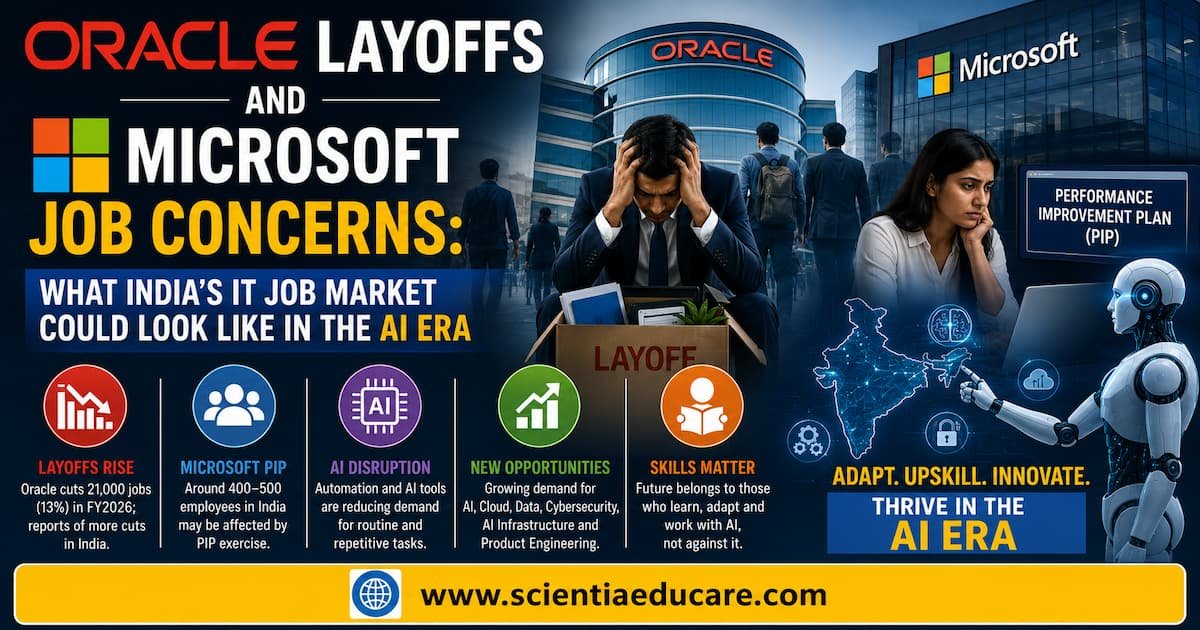
Oracle Layoffs and Microsoft Job Concerns: What India’s IT Job Market Could Look Like in the AI Era
India’s technology industry is entering a new phase.
For years, India’s IT sector grew by hiring large numbers of software engineers, support professionals, testers and other technology workers to deliver services to global companies. But the rapid adoption of artificial intelligence (AI), cloud computing, automation and AI-powered coding tools is changing that traditional model.
Recent developments involving Oracle and Microsoft have brought these concerns into sharper focus.
Oracle’s workforce fell by about 21,000 employees globally, or 13%, during fiscal 2026, while reports indicate that the company could undertake another round of job reductions. In India, reports have put the potential impact of the latest restructuring at thousands of roles.
Microsoft has also announced significant global job reductions this year, while reports on 1 September indicate that around 400–500 Microsoft India employees could be affected by a performance-improvement-plan exercise. A PIP is not the same as a confirmed layoff, so these reports should be treated differently from announced job cuts.
These developments raise a bigger question:
What will India’s IT job market look like when AI can perform many of the tasks that previously required large teams of entry-level and mid-level technology professionals?
The answer is unlikely to be simply “fewer jobs.”
Instead, India’s IT employment market could become smaller in some traditional roles, larger in new technology areas and significantly more skill-intensive overall.
Oracle Layoffs: Why the Company Is Under Pressure to Restructure
Oracle has become one of the clearest examples of how the AI boom can produce an unusual combination of massive technology investment and workforce restructuring.
According to Oracle’s fiscal 2026 reporting, its workforce declined from roughly 162,000 employees to about 141,000, a reduction of approximately 21,000 employees or 13%. The company also reported $1.84 billion in severance and other exit costs associated with restructuring during the year.
At first glance, this may appear contradictory.
Why would a technology company expanding aggressively in cloud and AI reduce its workforce?
The answer lies partly in where technology companies are putting their money.
Oracle is investing heavily in AI infrastructure and data centres, including computing capacity needed to support rapidly growing demand for AI services. Reuters has reported that Oracle has substantial future data-centre lease commitments as the company expands its AI infrastructure.
This creates a fundamental shift:
More investment in computing infrastructure does not necessarily mean more investment in human headcount.
A company can spend billions on chips, servers, cloud infrastructure and data centres while simultaneously trying to reduce labour costs.
What Is Happening With Oracle Jobs in India?
India is particularly important to Oracle because the country has a large technology workforce and major engineering and services operations.
Reports on 1 September 2026 said Oracle could undertake another round of layoffs affecting employees in India, although the precise scale and timing of the reported cuts remain uncertain. Earlier reports had indicated that managers were being asked to identify roles for possible reductions.
Separate reports have put the impact of recent Oracle workforce restructuring in India at approximately 3,000 roles, while earlier reporting had cited a much larger figure of around 10,000 Indian jobs in an earlier round. Because these figures come from media and industry sources rather than a single current Oracle announcement, they should not be treated as one definitive cumulative layoff number.
The broader message, however, is clear:
Traditional technology roles are coming under greater scrutiny as companies redesign their workforce around AI, cloud and automation.
Microsoft Job Concerns: What Is Happening?
Microsoft is facing a similar structural challenge, although its situation should not be described simply as “AI replacing Microsoft employees.”
The company announced approximately 4,800 job cuts globally in 2026, equivalent to around 2.1% of its workforce, amid a broader restructuring and continued heavy spending on AI infrastructure.
Reports published on 1 September also indicated that around 400–500 Microsoft employees in India could be affected by a global performance-improvement-plan exercise. Being placed on a PIP does not automatically mean termination, but such exercises can result in workforce reductions depending on individual outcomes and company decisions.
This distinction is important.
There are three different situations:
Layoff:
The employer eliminates the position or terminates employment as part of restructuring.
PIP:
An employee is formally given performance expectations and a period to improve.
Role transformation:
An existing job changes significantly because AI or automation alters how the work is performed.
These should not be treated as identical.
Why Are Big Tech Companies Cutting Jobs While Investing More in AI?
This is one of the biggest paradoxes of the current technology industry.
Companies are simultaneously:
- Spending billions on AI infrastructure
- Hiring AI specialists
- Expanding cloud computing
- Developing AI agents
- Automating repetitive work
- Reducing certain traditional roles
- Restructuring management
- Demanding greater productivity from employees
The objective is not necessarily to eliminate technology workers altogether.
Instead, companies want to produce more output with fewer people performing repetitive tasks.
For example, if an AI coding assistant allows one engineer to complete work that previously required several engineers, the organisation may need fewer people for that particular type of work.
This is particularly important for India’s traditional IT services model.
India’s Traditional IT Model Is Changing
India built a global technology-services advantage around a relatively simple economic proposition:
Large skilled workforce + competitive costs + global clients = scalable IT services.
Companies could hire thousands of engineers and assign teams to:
- Software development
- Testing
- Application maintenance
- Technical support
- Data processing
- Infrastructure management
- Business-process services
- Customer support
This model created enormous employment opportunities for Indian graduates.
But AI is challenging the economics of this approach.
AI coding tools can generate code.
AI assistants can analyse documents.
AI agents can automate workflows.
Generative AI can create reports, presentations and documentation.
Automated testing tools can reduce manual testing.
AI-powered support systems can handle routine customer queries.
Consequently, companies may no longer need the same number of people for certain categories of work.
Reuters recently reported that India’s roughly $315 billion IT-services industry is shifting toward outcome-based contracts, with clients demanding greater productivity and lower costs while some tasks are increasingly being handled internally using AI.
The Biggest Risk: Entry-Level IT Jobs
One of the most important consequences of AI could be a change in the entry-level technology job market.
Historically, many Indian IT companies operated a pyramid structure:
Large number of junior employees → fewer mid-level professionals → smaller number of senior specialists
This structure worked because junior workers could perform relatively standardised tasks at scale.
AI is increasingly capable of assisting with many of those standardised tasks.
That creates a difficult question:
If AI reduces the number of entry-level tasks, how will graduates gain the experience required to become senior technology professionals?
This could become one of India’s most important employment challenges in the AI era.
The problem is not simply the number of jobs.
It is also the career ladder.
AI May Reduce Some Jobs but Increase Demand for Other Skills
The future is unlikely to be a simple story of humans versus machines.
Instead, the employment market could become divided into different categories.
Jobs Under Greater Automation Pressure
Roles involving highly repetitive and predictable tasks may face greater pressure.
Examples include:
- Basic coding
- Manual software testing
- Routine data processing
- Basic technical support
- Repetitive documentation
- Simple reporting
- Standardised content production
- Low-complexity back-office operations
This does not mean these jobs will disappear completely.
It means fewer people may be required to perform the same volume of work.
Jobs Likely to Become More Valuable
At the same time, demand could increase for professionals who can design, supervise, secure and implement AI systems.
Potentially strong areas include:
- Artificial intelligence
- Machine learning
- Data engineering
- Cloud computing
- Cybersecurity
- AI infrastructure
- Semiconductor technology
- Robotics
- Automation
- DevOps
- Platform engineering
- Enterprise architecture
- AI governance
- Technology consulting
AI itself therefore creates a new category of work.
Someone needs to:
Build the AI → deploy the AI → integrate the AI → monitor the AI → secure the AI → govern the AI.
The Rise of the AI-Augmented Employee
One of the most important concepts for Indian workers may be the AI-augmented professional.
Instead of competing directly against AI, employees will increasingly be expected to use AI as part of their everyday work.
For example:
Software Developer
Traditional model:
Write code manually.
AI-era model:
Design the solution, use AI to generate code, review the output, test it, secure it and integrate it into the wider system.
Data Analyst
Traditional model:
Prepare spreadsheets and reports manually.
AI-era model:
Use AI to process data, identify patterns, validate results and provide business recommendations.
Marketing Professional
Traditional model:
Create campaigns manually.
AI-era model:
Use AI for research and content generation while focusing on strategy, customer behaviour and brand positioning.
The valuable skill is therefore shifting from performing every task manually to directing technology effectively.
What Does This Mean for India’s IT Services Companies?
Indian IT companies are facing pressure from both sides.
From clients:
“Deliver more value at lower cost.”
From technology:
“AI can automate many existing tasks.”
From employees:
“Provide better career opportunities and higher-value work.”
This is forcing companies to rethink their business models.
Reuters reports that large Indian IT companies including TCS, Infosys, Wipro, HCLTech and Cognizant are increasingly shifting toward performance-based contracts and investing in AI capabilities.
This could mean fewer large outsourcing contracts based simply on the number of employees assigned.
Instead, clients may increasingly pay for:
- Business outcomes
- Software products
- AI implementation
- Cloud transformation
- Cybersecurity
- Data platforms
- Automation
- Digital engineering
Could India’s IT Job Market Shrink?
Yes, some parts could.
But that does not necessarily mean India’s entire technology workforce will decline dramatically.
The bigger change could be composition.
Imagine an IT company that previously required:
1,000 employees
to deliver a particular service.
With AI and automation, perhaps it can deliver the same service with:
600 employees
But the company may also create a new AI business requiring:
200 AI specialists, cloud engineers and cybersecurity professionals.
The total workforce could still change, but the skill composition would be dramatically different.
This is why job transformation may be more important than job elimination.
India Has an Important Advantage: Global Capability Centres
India is not only an outsourcing destination anymore.
It has become a major hub for Global Capability Centres (GCCs) operated by multinational companies.
These centres increasingly perform high-value activities involving:
- Product development
- Engineering
- Artificial intelligence
- Data science
- Finance
- Research
- Cybersecurity
- Cloud architecture
- Global operations
Reuters reported earlier this year that India hosts more than half of the world’s global capability centres, although hiring is becoming more measured as companies assess the impact of AI and geopolitical uncertainty.
This creates both an opportunity and a challenge.
India could attract more high-value technology work.
But companies may require fewer workers with significantly higher skill levels.
India’s AI Opportunity Could Be Much Bigger Than IT Services
India’s AI economy is not limited to software companies.
AI is increasingly being applied to:
- Banking
- Healthcare
- Manufacturing
- Agriculture
- Education
- Logistics
- Retail
- Insurance
- Telecommunications
- Defence
- Energy
India’s recent investment cycle is also increasingly connected to data centres, semiconductors, advanced manufacturing and AI infrastructure. Reuters reported that India’s private investment revival is extending into these sectors as companies expand technology infrastructure.
This means new technology jobs could emerge outside traditional IT services.
What Skills Will Matter Most in India’s AI Era?
For students and working professionals, this is perhaps the most important question.
The answer is not simply:
“Learn AI.”
AI is a broad field.
Professionals should develop a combination of technical skills + domain knowledge + human skills.
1. AI and Machine Learning
Understanding how AI systems work will become increasingly valuable.
2. Data Skills
AI depends heavily on high-quality data.
Skills in:
- SQL
- Python
- Data engineering
- Statistics
- Data visualisation
can remain highly relevant.
3. Cloud Computing
AI applications require cloud infrastructure.
Knowledge of major cloud platforms and distributed systems can therefore provide an advantage.
4. Cybersecurity
As AI adoption grows, AI-enabled cyber threats also increase.
More than 100 major companies, including Microsoft and Oracle, recently called for stronger defences against AI-driven cyberattacks.
5. Domain Expertise
A person who understands both AI and a specific industry may become particularly valuable.
Examples:
AI + Finance
AI + Healthcare
AI + Manufacturing
AI + Education
AI + Law
AI + Marketing
6. Communication
Technology alone is not enough.
Professionals must explain technical concepts to clients, managers and non-technical teams.
7. Problem-Solving
AI can generate answers.
Humans still need to determine:
- What problem should be solved?
- Is the answer correct?
- What are the risks?
- What should the organisation do next?
What Should Indian IT Professionals Do?
The biggest mistake professionals can make is assuming that AI disruption is something that will happen years from now.
It is already affecting work.
Professionals should therefore consider a practical strategy.
Step 1: Identify Your Routine Tasks
Ask:
Which parts of my job could AI automate?
This is not a reason to panic.
It is a reason to prepare.
Step 2: Learn the AI Tools Used in Your Industry
Don’t learn AI only theoretically.
Use it in your actual work.
Step 3: Move Toward Higher-Value Responsibilities
Try to progress from:
Task execution → problem solving → system design → decision making
Step 4: Build a Portfolio
Demonstrate what you can actually build or improve.
Projects can be more persuasive than certificates alone.
Step 5: Develop Domain Expertise
A generic AI skill may have limited value.
AI combined with industry knowledge can be much more powerful.
What Should Fresh Graduates Do?
The situation may be more challenging for fresh graduates because companies may hire fewer people for routine entry-level roles.
However, this does not mean graduates should avoid technology careers.
Instead, they should prepare differently.
Students should focus on:
- Programming fundamentals
- Data structures
- Databases
- Cloud computing
- AI tools
- Data analysis
- Cybersecurity fundamentals
- Communication
- Problem-solving
- Projects
- Internships
Most importantly, students should learn how to use AI productively without becoming dependent on it.
If an AI tool writes code, the graduate should still understand the code.
If AI generates an answer, the graduate should know how to verify it.
If AI produces a report, the graduate should be able to identify errors.
That ability to judge AI output could become one of the most valuable workplace skills.
Will AI Make Computer Science Degrees Less Valuable?
Not necessarily.
But the value proposition is changing.
A computer science graduate who knows only basic programming may face more competition from AI tools.
A graduate who understands:
computer science + AI + cloud + data + cybersecurity + business problems
could be significantly better positioned.
The degree provides the foundation.
Continuous learning determines how valuable that foundation remains.
Could AI Create More Jobs Than It Destroys?
Possibly—but the timing and distribution matter.
Technology has historically created new occupations while eliminating others.
The challenge with AI is that the transition may happen faster.
A new AI-related industry may create jobs, but workers displaced from traditional roles may not immediately possess the required skills.
This creates a potential skills-transition gap.
For India, this could become especially important because millions of young people enter the labour market every year.
The country therefore needs not only AI innovation but also large-scale reskilling and upskilling.
The Bigger Challenge: Job Quality
India’s technology sector has been an important source of relatively well-paid urban employment.
If AI causes companies to reduce routine roles while concentrating opportunities among highly skilled professionals, wage inequality within the technology sector could increase.
The market could increasingly look like:
High demand + high salaries
for advanced AI, cloud, cybersecurity and engineering specialists.
At the same time:
High competition + slower salary growth
for routine technology and support roles.
This could create a more polarised IT employment market.
AI Could Also Create New Opportunities for Smaller Companies
The AI revolution may not benefit only large technology companies.
Smaller Indian businesses can use AI to compete with larger firms by reducing costs and improving productivity.
For example:
- A small software company can use AI coding tools.
- A startup can automate customer support.
- A small marketing agency can use generative AI for research and content.
- A manufacturing company can use AI for predictive maintenance.
- A retailer can use AI for demand forecasting.
This could lower the cost of starting and scaling technology-driven businesses.
What Does the Oracle-Microsoft Story Tell Us?
The Oracle and Microsoft developments should not be interpreted as proof that “AI is eliminating all technology jobs.”
The reality is more complicated.
The companies are investing heavily in AI because they expect the technology to create significant economic value.
At the same time, they are restructuring their organisations because the economics of technology work are changing.
The message for workers is therefore:
The question is no longer whether AI will affect your job. The question is how your job will change because of AI.
India’s IT Job Market in 2030: What Could It Look Like?
No one can predict the exact employment numbers for 2030.
But several trends are already visible.
Possible Trend 1: Fewer Routine Roles
Automation could reduce demand for repetitive technology work.
Possible Trend 2: More AI Specialists
Demand for AI engineers, data scientists and AI infrastructure professionals could grow.
Possible Trend 3: Smaller but More Skilled Teams
Companies may increasingly rely on smaller teams equipped with powerful AI tools.
Possible Trend 4: More Product Engineering
India could continue moving from outsourcing toward product development and high-value engineering.
Possible Trend 5: More GCC Jobs
Multinational companies could expand high-value operations in India.
Possible Trend 6: Continuous Reskilling
The traditional idea of learning one technology and using it for an entire career may become increasingly outdated.
What Employers May Look for in the Future
Recruitment may increasingly focus on demonstrated capability rather than simply degrees or years of experience.
Employers could increasingly ask:
Can you use AI effectively?
Can you solve complex problems?
Can you work with data?
Can you understand the business problem?
Can you validate AI-generated outputs?
Can you build secure and reliable systems?
Can you work across multiple technologies?
These questions could become more important than simply asking how many programming languages a candidate knows.
What This Means for India’s Economy
The IT industry is not an isolated sector.
Technology employment supports:
- Urban consumption
- Housing
- Education
- Banking
- Retail
- Transportation
- Real estate
- Professional services
A significant slowdown in IT hiring could therefore affect broader urban economic activity.
On the other hand, if AI helps Indian companies become more productive and move into higher-value services, the economic benefits could be substantial.
India’s challenge is therefore to ensure that productivity gains translate into new investment, new industries and new employment opportunities.
The Most Important Lesson for Job Seekers
There is a temptation to respond to AI anxiety by learning every new AI tool.
That is not necessarily the best strategy.
Tools change quickly.
Fundamentals last longer.
A strong professional foundation should include:
Technical knowledge + AI literacy + domain expertise + communication + problem-solving + adaptability
Someone who has all six may be better positioned than someone who knows dozens of AI tools but lacks fundamental expertise.
Conclusion
The latest developments involving **Oracle and Microsoft provide a warning—but also an opportunity—for India’s technology workforce.
Oracle’s workforce reduction of about 21,000 employees during fiscal 2026 and reports of further restructuring demonstrate how aggressively technology companies are changing their cost structures while investing in AI infrastructure.
Microsoft’s global job cuts and reported PIP exercise affecting hundreds of employees in India similarly highlight the growing focus on productivity, performance and workforce redesign.
But the lesson should not be that AI means the end of IT jobs.
The more accurate lesson is:
AI is changing which IT jobs are valuable.
Routine coding, testing, support and administrative technology work may face increasing automation.
Meanwhile, AI engineering, cloud computing, cybersecurity, data engineering, AI infrastructure, product development and technology consulting could become increasingly important.
For India, the opportunity is enormous.
The country already has a large technology workforce, a strong engineering base and a growing ecosystem of global capability centres. If workers and educational institutions can adapt quickly enough, India could move from being primarily a provider of technology labour to becoming a major global centre for AI engineering, products, research and innovation.
But that transition will not happen automatically.
Companies will need to invest in reskilling.
Educational institutions will need to modernise curricula.
Students will need to learn continuously.
And professionals will need to move beyond routine task execution toward problem-solving, creativity, technical judgment and domain expertise.
The future of India’s IT job market may therefore be smaller in some traditional categories—but potentially much bigger in higher-value technology roles.
The winners of the AI era are unlikely to be those who simply compete with AI. They will be the professionals and organisations that learn how to work effectively with it.
Frequently Asked Questions (FAQs)
1. Are Oracle layoffs related to AI?
Oracle has said in its reporting that AI adoption and deployment have contributed to workforce reductions, while the company is also restructuring and investing heavily in AI infrastructure. Its workforce fell by about 21,000 employees in fiscal 2026.
2. Is Oracle laying off employees in India in September 2026?
Reports indicate that Oracle may undertake another round of workforce reductions affecting India, but the exact scale and timing of the reported latest cuts remain uncertain. Separate reports have estimated thousands of Indian roles could be affected.
3. Is Microsoft laying off employees in India?
Microsoft has announced global job reductions in 2026. Separately, reports indicate that around 400–500 Microsoft India employees may be affected by a performance-improvement-plan exercise. A PIP should not automatically be described as a confirmed layoff.
4. Will AI eliminate IT jobs in India?
AI is likely to automate some routine technology tasks and change the number and type of workers required for certain roles. At the same time, new opportunities are emerging in AI, cloud, data, cybersecurity, infrastructure and product engineering.
5. Which IT jobs are most at risk from AI?
Highly repetitive and predictable tasks—including some basic coding, manual testing, routine support and data-processing activities—are more exposed to automation.
6. Which IT jobs are likely to grow because of AI?
Potential growth areas include AI engineering, machine learning, data engineering, cloud computing, cybersecurity, AI infrastructure, automation, platform engineering and AI governance.
7. Should students still study computer science?
Yes. Computer science fundamentals remain valuable. However, students should combine them with AI literacy, data skills, cloud knowledge, communication and problem-solving abilities.
8. Will India’s IT sector continue to grow?
India’s technology sector is likely to continue growing, but the employment model may change. Companies may increasingly focus on higher productivity, AI-enabled services and specialised skills rather than very large numbers of entry-level workers.
9. What should IT professionals do to protect their careers?
Professionals should continuously upgrade their skills, learn relevant AI tools, develop domain expertise, understand their business context and move toward work involving complex problem-solving and decision-making.
10. Is AI an opportunity or a threat to Indian IT workers?
It is both. AI threatens some routine jobs but creates opportunities in new technology areas. The biggest determining factor will be how quickly workers, companies and educational institutions adapt.